
Denim bulk production and sample consistency: verification boundaries for cargo pants pocket construction
Cargo pants pockets involve structure, placement, and construction, making them one of the areas most prone to deviation in bulk-versus-sample consistency. From a buyer's perspective on verifying bulk production, this article explains which items need to be checked for pocket consistency, what photos can and cannot show, and how to set judgment boundaries when complete specifications are unavailable. It is intended as a reference for brands and wholesalers developing or approving cargo pants orders.
Pocket consistency between bulk production and samples cannot be judged from photos alone; approved samples and written specifications must serve as the verification basis, with dimensions, placement, stitching, and trims confirmed item by item.
In this article
What items are checked for pocket consistencyWhat photos can and cannot verifyDuring sample review, pocket feedback should specify the part and the valueHow to check pockets during bulk productionWhen pocket construction changes, consistency judgment must be redone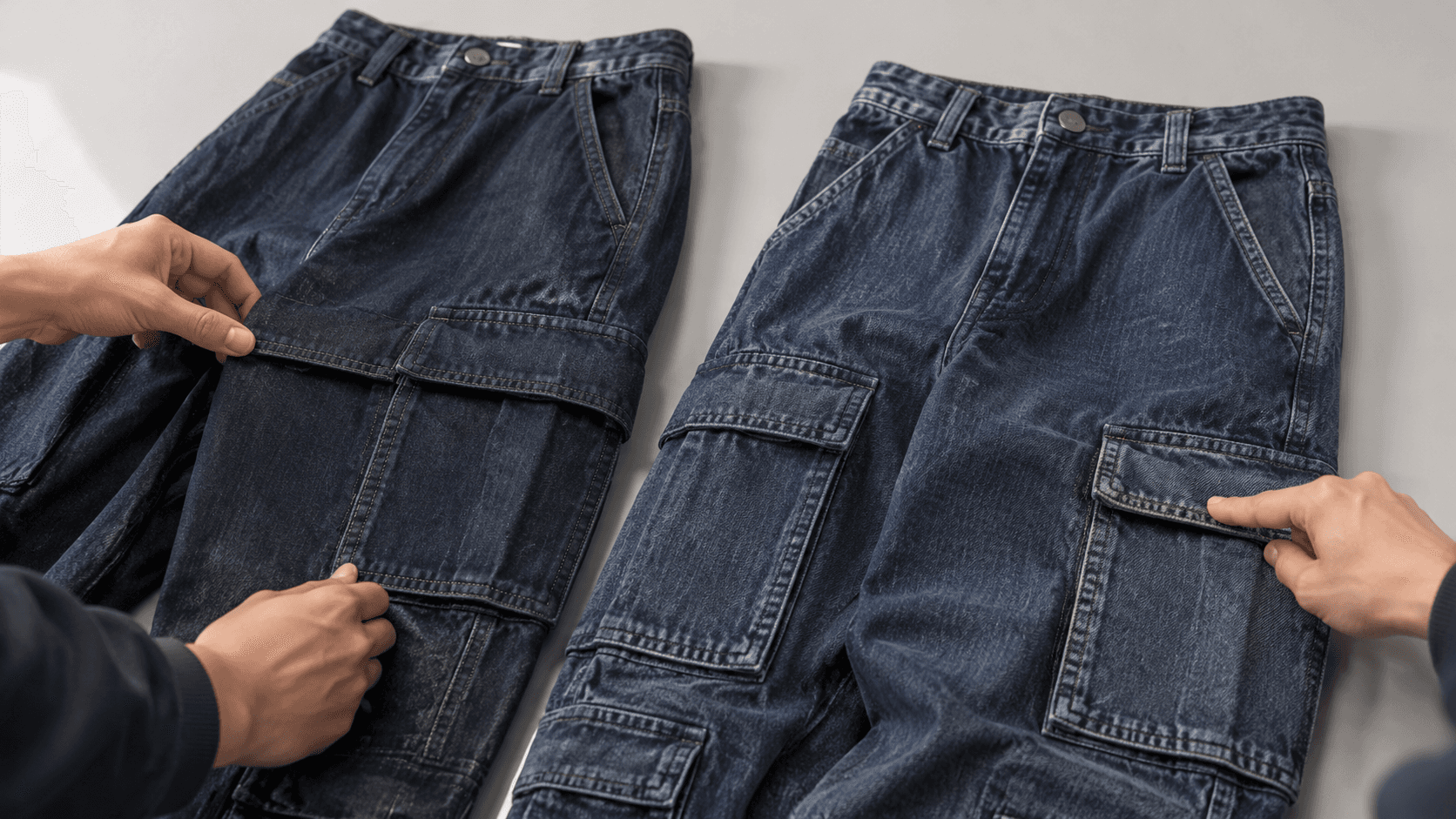
Workwear pocket checks are one of the items most easily skipped when verifying consistency between bulk denim production and samples. The overall fit may look close, but if pocket placement is off by 1 cm, the flap shape has changed, or stitch density differs, wearability and sales feedback can be completely different. However, pocket consistency cannot be concluded from looking at bulk production photos—the only basis for verification is the approved sample and the written specifications confirmed by both parties.
What items are checked for pocket consistency
Workwear pockets typically include pocket bags, flaps, patch pockets, or side pockets, involving more positions and construction details than standard five-pocket styles. When checking consistency, at minimum the following items should be confirmed separately:
- Pocket type and structure: patch pocket, flap pocket, 3D pocket, or paneled pocket; whether there are pleats or seam lines.
- Position and dimensions: pocket opening width, pocket depth, distance from pocket to side seam or waistband, and whether left and right are symmetrical.
- Stitching: number of topstitch rows, stitch length, whether bar-tack reinforcement is used, whether the pocket opening is bound.
- Trims: specifications, colors, and attachment positions of buttons, rivets, zippers, and hook-and-loop fasteners.
- Post-wash condition: whether the abrasion, whiskering, or distressed effects on pocket edges match the sample.
If these items are only recorded in chat messages and not documented in a spec sheet or marked on the sample, there is no reference version to check against during bulk production.
What photos can and cannot verify
Flat-lay or detail photos can indicate the general appearance and design direction of pockets, but cannot serve as evidence of fiber composition, fabric weight, shrinkage, or stitching parameters. A pocket detail photo cannot show the stitch length, what material the pocket bag is made of, or whether the pocket opening will deform after washing.
If the customer only provides reference images, the sales team can use them to discuss style direction, but the final consistency judgment must still be based on the confirmed sample and written specifications. Reference images are affected by lighting and screen display, so color and texture cannot be used as a color difference standard. For more on what flat-lay photos can verify, see the article "Denim Bulk Production vs. Sample Consistency: What Can Be Verified from a Flat-Lay Photo."
During sample review, pocket feedback should specify the part and the value
After receiving the sample, it is recommended to consolidate all pocket-related comments at once rather than supplementing verbally over multiple rounds. When giving feedback, annotate the part on photos and state the target result, for example: "narrow the flap width by 5 mm," "change the pocket opening topstitch from double to single row," "move the pocket position up 1 cm." Distinguish between must-change items and acceptable differences to avoid conflicting comments across rounds.
Keep version numbers and confirmation records for each round of changes. When pocket changes involve materials or structure, re-check cost and lead time at the same time. Sample approval means both parties have confirmed the production reference, but it does not mean the factory can decide unconfirmed details on its own.
How to check pockets during bulk production
Bulk production uses the specification version confirmed by both parties. When checking pockets, inspect item by item against the approved sample: whether pocket positions are symmetrical, whether flap shapes are consistent, whether stitch rows and stitch length are within the agreed range, and whether trims match the confirmed version. When deviations are found, record the style number, quantity, photos, and measurement results, and confirm the handling plan with the sales team.
If the customer requires a specified sampling plan or third-party inspection, this should be raised before placing the order, with arrangements, costs, and responsibilities confirmed. Without documentation, no AQL level or inspection pass rate can be promised. General quality inspection recommendations do not mean ZHIZHI has obtained any particular testing certification.
When pocket construction changes, consistency judgment must be redone
Fabric substitution, wash adjustments, or pocket structure modifications can all affect the final state of pockets. Changes in fabric thickness will alter flap stiffness, and changes in wash intensity will affect the distressed effect on pocket edges. After changes, the sample should be re-checked; the old version cannot simply be treated as equivalent.
If the customer wants to adjust pocket design, custom development options can be discussed starting from reference styles, but development feasibility, materials, construction, pricing, and scheduling need to be confirmed before proceeding to samples. Available styles and custom development references are different sourcing paths; custom styles cannot be described as existing stock ready for immediate shipment.
The boundary for judging pocket consistency is this: without an approved sample and written specifications, there is no verification baseline; once a baseline exists, item-by-item comparison is what distinguishes acceptable differences from deviations that need to be addressed.