
How to control budget in denim collection development: first clarify which materials can serve as a quoting basis
For brands and buyers who need to develop a full-season denim collection or custom single styles, this article discusses how budget overruns often stem from unclear quoting bases rather than factory unit prices. It breaks down by style structure, fabric and wash, trims and packaging, quantity and delivery timeline to explain which conditions must be confirmed in advance and which can only be verified through sample garments, and points out that reference images and available styles pages cannot replace specifications and quotations.
The key to budget control is not squeezing unit prices, but writing style, quantity, fabric, wash, trims, packaging and delivery terms into the requirement brief item by item; when information is incomplete, quotes cannot be compared, and subsequent revisions will add cost.
In this article
How to control the budget for denim collection development: first clarify which materials can serve as a basis for quotationReference images can set direction, but cannot set a quotationFabric and wash: once changed, the budget must be recalculatedTrims and packaging are easily omittedQuantity basis determines unit price and also whether production is possibleThe starting point for lead time must be written into the orderManage the budget with confirmation points, not with memory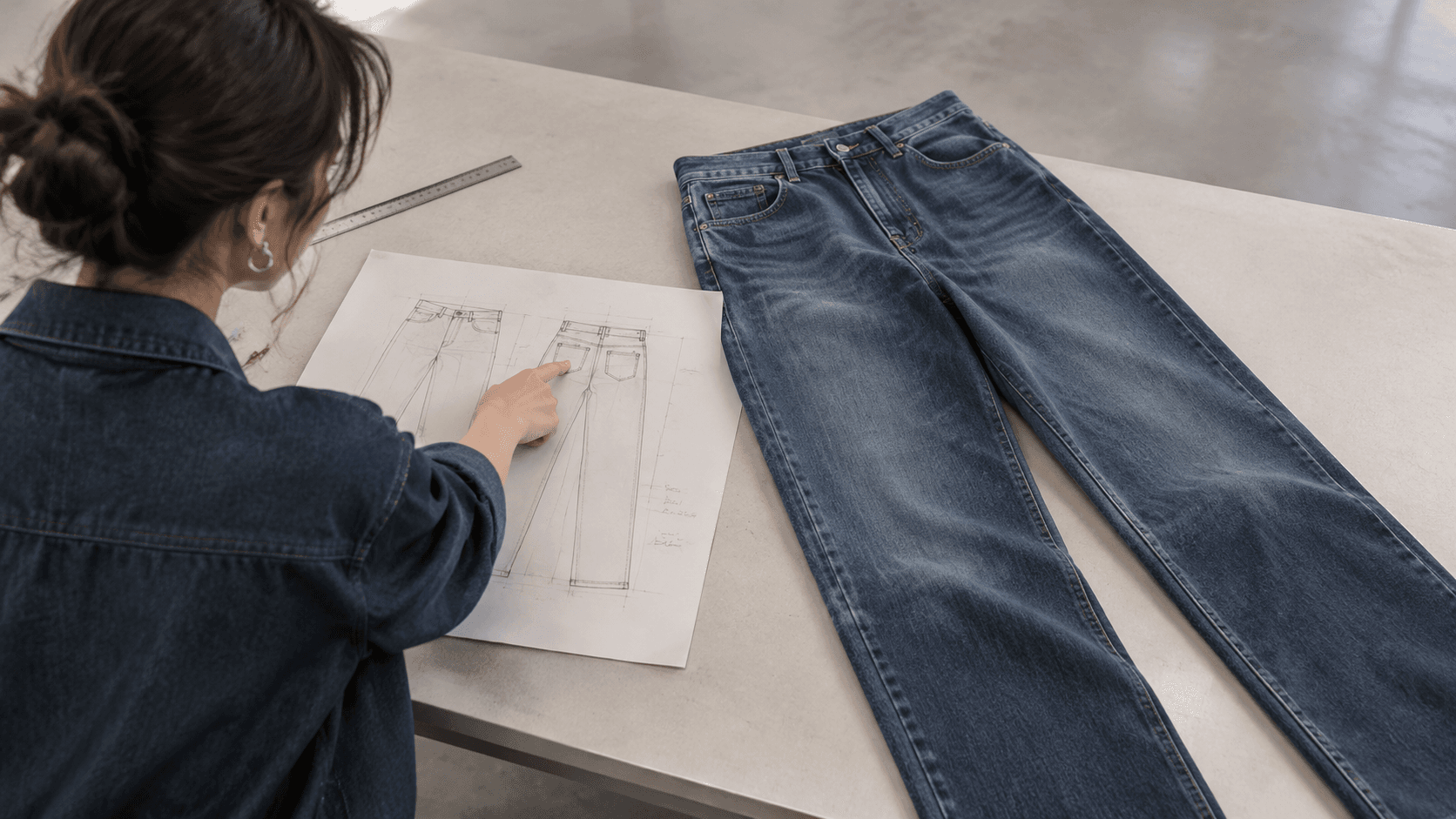
How to control the budget for denim collection development: first clarify which materials can serve as a basis for quotation
Controlling the budget for denim collection development usually does not mean pushing the unit price to the lowest possible level, but first making every quotation based on verifiable references. If any item among style, quantity, fabric, wash, trims, packaging, and delivery terms is not clearly specified, quotations lack comparability, and subsequent revisions and material replenishment will come back in the form of additional charges.
Reference images can set direction, but cannot set a quotation
Model shots, flat-lay images, and detail images in the custom product gallery are sufficient for communicating style structure and design direction. However, images do not prove that physical samples, available stock, or mass production capability already exist, nor can accurate composition and process parameters be derived from them. If you ask for a price directly based on a reference image, the factory can only provide a range or assumptions, and that number cannot be used for horizontal comparison.
A more effective approach is to break the reference image into confirmable items: which silhouettes must be retained, which pocket positions can be adjusted, and which wash details are only illustrative. Clearly marking pending items as to be confirmed is easier to move forward than finding several more similar images.
Fabric and wash: once changed, the budget must be recalculated
Fabric communication starts with use, season, hand feel, thickness, stiffness or softness requirements, and whether stretch is needed. Accurate parameters such as composition, weight, yarn, and structure should come from confirmed product specifications, fabric documentation, or sample records, and cannot be judged from photos. For styles requiring stretch, stretch, recovery, and garment fit requirements should be confirmed at the same time.
The same applies to wash. Customers can provide target color samples, reference garments, or clear images, and explain processing requirements such as light or dark shades, whiskers, grinding, holes, and frayed edges. However, reference images are affected by lighting and screens and cannot serve as an absolute color difference standard; with different fabrics and structures, the same treatment may present different hand feel and color.
The key budget judgment here is: fabric substitution or wash adjustment may simultaneously affect color, hand feel, garment dimensions, and sample rounds. After changes, samples should be rechecked and cannot be directly regarded as equivalent substitutions. Each additional sample round adds another round of material, labor, and shipping costs.
Trims and packaging are easily omitted
Brand details may include main labels, care labels, leather patches, buttons, rivets, zippers, hangtags, and packaging. These items often have separate quantity, cost, and lead time requirements and should be confirmed item by item during quotation; they cannot be assumed to be all free or customizable in any quantity.
Customers need to provide usable artwork, dimensions, colors, positions, and quantity requirements, and confirm authorization for the use of graphics and trademarks. Labeling information and material claims are subject to confirmed materials, and label content for different markets needs to be checked against specific requirements. If trim artwork is finalized only after sample approval, production scheduling and budget must be coordinated again.
Quantity basis determines unit price and also whether production is possible
Quotation communication should take into account style, quantity, fabric, wash, trims, brand customization, packaging, and delivery requirements. The range prices and tiered prices on available stock pages are not minimum prices applicable to any quantity; they should be verified according to the total quantity of the same style and current specifications. Custom products are quoted according to requirements and do not use available stock prices.
Minimum order quantities also need to be checked for calculation method: some custom development reference styles on the website indicate a minimum of 30 pieces per style, while minimum order quantities for other custom styles still need to be confirmed by proposal; 30 pieces cannot be treated as a uniform commitment for all styles, fabrics, or colors. For available stock items, the minimum order quantity shown on the current detail page and ordering window prevails, and some items support a minimum of 1 piece with mixed sizes in the same style. When quantities are small, you can first discuss available stock trial sales or sample development, then verify whether custom production can be arranged.
When comparing quotations, you should also confirm whether sample fees, trims, packaging, shipping, taxes, and other services are included. Unless confirmed in a quotation, do not assume free shipping, tax inclusion, or free sampling.
The starting point for lead time must be written into the order
The factory capacity figure provided by the project lead is 300,000 pieces, corresponding in prior communications to monthly capacity; before formally using the monthly basis with customers, the sales team should reconfirm the statistical scope and currently available scheduling. The lead explained sampling takes 3 days, bulk delivery is within 30 days depending on volume, and available stock ships the same day. These are capabilities and arrangements that need to be confirmed against specific orders and cannot be guaranteed to apply unconditionally to all styles.
The actual budget impact is: the confirmation point from which lead time starts still needs to be written into the order. Shipping does not equal arrival; transportation and customs clearance time are calculated separately. If sampling, sample approval, bulk scheduling, and transportation are combined into one arrival promise, later rush production or changing transportation methods will generate additional costs.
Manage the budget with confirmation points, not with memory
Custom development can be divided into five stages: communicating requirements, confirming the proposal, sampling and review, approving samples and production, and quality inspection, packaging, and shipment. Each stage should have a clear confirmation result, and the latest version should be synchronized after modifications to avoid inconsistency among drawings, samples, and orders. During sample review, gathering feedback at one time on fit, dimensions, fabric hand feel, color and wash, stitching, trims, and label positions, and distinguishing must-change items from acceptable differences, can reduce back-and-forth rounds.
When you need to see the specific service scope, you can refer to custom denim development and private label services to confirm the boundaries of communication; if the current goal is replenishment for trial sales, first proceed with available stock denim sourcing, checking sizes, quantities, inventory, and shipping arrangements style by style, and do not treat custom development reference styles as existing stock.
At this point in budget control, the judgment boundary is actually very clear: only items that can be checked against confirmed specifications, approved samples, and quotations enter budget comparison; items that can only rely on images and verbal descriptions should first be marked as to be confirmed and not folded into the unit price in advance.