
Jean Size Charts and Tolerances: Stock Verification vs. Custom Confirmation—Which Chart to Align First
When sourcing jeans, stock and custom orders have different requirements for size charts and tolerances. Stock orders require checking available sizes, inventory, and pre-wash/post-wash states; custom orders require key measurement points based on the target market, with measurement methods, units, and allowed tolerances confirmed at the sample stage. This article compares the two paths in terms of sizing basis, tolerance agreements, and change handling, helping buyers decide which chart to align first for their current project.
Stock orders verify sizes and inventory against the current order window; custom orders use approved samples and confirmed specifications as acceptance criteria. The two cannot share the same size chart, and tolerances must be agreed separately.
In this article
Available styles: check listed sizes first, then discuss tolerancesCustom: complete measurement points in the size chart for the target marketTolerance agreements: available styles rely on page records, custom goes into the confirmed versionWhen changes occur, first identify which chart is affectedApplicable conditions for each path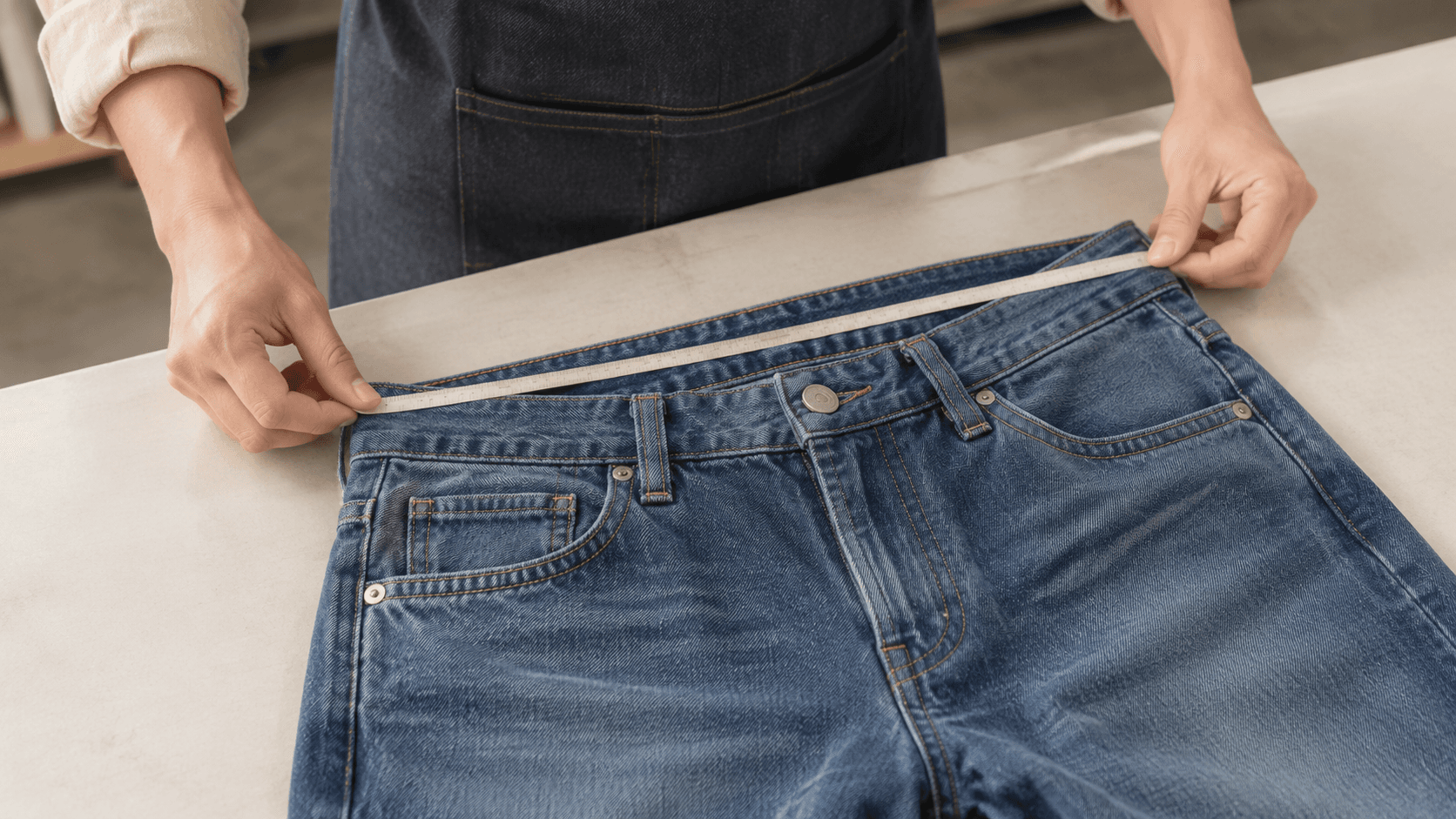
When sourcing jeans, which size chart and tolerance should prevail depends on whether you are buying available styles or going custom. For available styles, the size basis is the sizing information shown on the current product page and ordering window; for custom development, the size basis is the confirmed specification version and approved sample garment. The two paths cannot share the same chart, nor can available-style sizes be treated as a custom commitment.
Available styles: check listed sizes first, then discuss tolerances
The starting point for available-style sourcing is the current ordering window. Sizes, availability, minimum order quantities, and prices are subject to what the window shows and business confirmation; the knowledge base does not store fixed inventory figures. Buyers need to verify available sizes style by style, rather than inferring from product titles or reference images.
As for tolerances, available styles usually leave no separate room for negotiation. If the product page does not state the measurement method or pre-wash/post-wash status, confirm the size records for that batch with the business team. If sizes are missing or quantities exceed the available range, contact the business team to confirm supply or move the discussion to custom development.
Custom: complete measurement points in the size chart for the target market
For custom development, customers need to provide a size chart or key body measurements for the target market, such as waist, hip, front and back rise, inseam, thigh, and leg opening. For tops and dresses, complete the corresponding measurement points according to the specific structure. S, M, and L labels in different markets cannot be directly treated as the same size.
During sampling, verify the measurement method, size unit, pre-wash or post-wash status, and allowed tolerances. Record fitting feedback where necessary. Bulk production uses the specification version confirmed by both parties; the fit of all sizes cannot be inferred solely from a model's body shape.
Tolerance agreements: available styles rely on page records, custom goes into the confirmed version
| Condition to confirm | Available styles | Custom |
|---|---|---|
| Size basis | Sizes shown in the current ordering window | Target-market size chart or key body measurements provided by the customer |
| Measurement method and unit | Confirm batch records with the business team | Verify during sampling and write into the specification version |
| Pre-wash/post-wash status | Subject to the product page or business notes | Clarify and record at the sample garment stage |
| Allowed tolerance | Usually not separately negotiated; subject to actual records | Written into the specification version after both parties confirm |
| Change handling | If sizes are missing, contact the business team to confirm supply | After changes, re-check the sample garment and sync the version |
This table lists only verifiable check items. "To be confirmed" in the available-style column is not a defect; it means that under the available-style path, tolerance information must be requested from the business team and cannot be assumed to be the same as custom. Tolerances in the custom column must also be confirmed item by item; industry habits cannot replace what both parties agree.
When changes occur, first identify which chart is affected
When restocking available styles, if sizes do not match, first check the size records in the current ordering window and actual availability, then decide whether to switch sizes or move to custom. During custom development, changing fabric or adjusting structure may affect color, wash, hand feel, and garment dimensions. After changes, re-check the sample garment rather than treating it as an equivalent substitute.
Wash processing also affects dimensional performance. Customers may provide target color samples or reference garments, but reference images are affected by lighting and screens and cannot serve as an absolute color difference standard. With different fabrics and structures, the same processing may produce different hand feel and color; confirm the effect through sample garments.
Applicable conditions for each path
When quick restocking or test selling is needed, the available-style path is more direct, provided that the current window has available sizes and the buyer accepts size information based on actual records. When changing fit, fabric, wash, or brand labels, the custom path is more suitable, provided that the customer can provide a target-market size chart and key body measurements and is willing to confirm measurement methods and tolerances item by item at the sample garment stage.
If the customer has neither a complete size chart nor the need for fast delivery, neither path's conditions are met. In that case, first clarify the target market, key dimensions, and budget, then decide whether to find the closest available size or proceed to custom sampling.