
How should denim shrinkage be communicated? First distinguish before-wash vs. after-wash and the testing basis
When sourcing denim, mismatched shrinkage figures are often not because someone reported them incorrectly, but because the measurement state and testing basis differ. Starting from the garment spec sheet, this article explains the difference between before-wash and after-wash, fabric testing and garment testing, and provides checkpoints that can be carried out at the sample stage, helping brands and buyers put shrinkage communication into reviewable records before confirming a spec version.
To communicate shrinkage, first agree on the measurement state: before wash, after wash, or after multiple washes, and clarify the test method and allowed tolerance; otherwise the numbers cannot be aligned.
In this article
First, clarify: does this percentage refer to before or after washing?Garment size sheets must indicate measurement stateWash effects can change shrinkage behaviorList shrinkage as a separate check item during sample reviewBulk consistency relies on specification versions, not verbal promises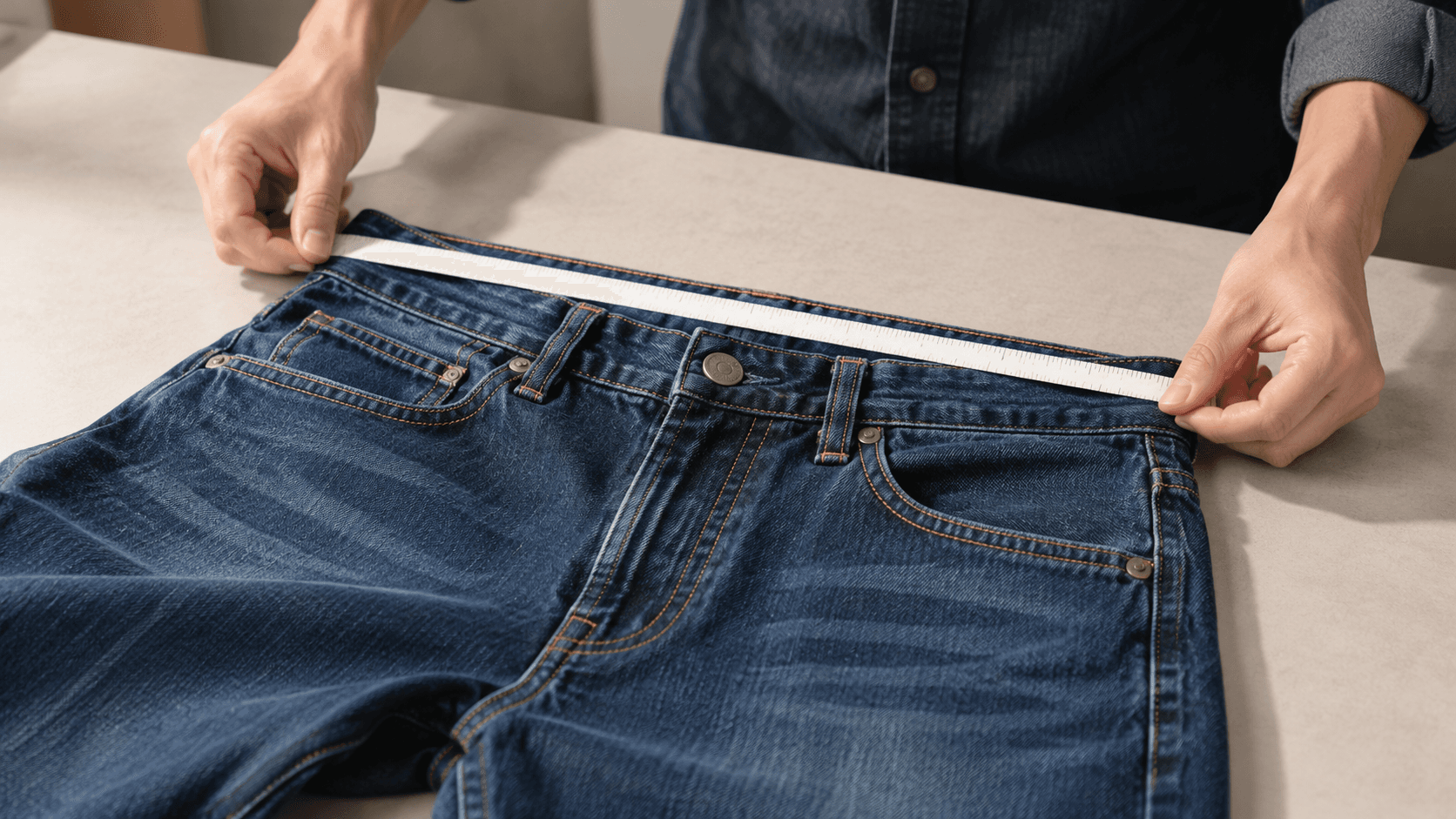
For the same pair of jeans, a supplier may quote a 3% shrinkage rate, yet when you measure the sample garment yourself, it comes out at 6%. The problem is usually not the number itself, but that the two sides are not talking about the same state. The first step in communicating about shrinkage is to clarify "at which stage, by what method, and which measurement point" before discussing values.
First, clarify: does this percentage refer to before or after washing?
Fabric shrinkage and garment shrinkage are two different measures. Fabric testing typically involves washing a fabric swatch according to an agreed method and then measuring dimensional change; garment testing requires measuring the same point on the garment before and after washing, based on the garment's measurement points. The two cannot be directly interchanged, nor can fabric data be used to infer garment performance.
At minimum, confirm three things during communication: whether fabric or garment is being measured; which version the pre-wash dimensions are based on; and whether post-wash refers to a single wash or multiple washes. Without any one of these, the shrinkage figure can only serve as a reference, not as a basis for acceptance.
Garment size sheets must indicate measurement state
When communicating about fit and size charts, key measurement points such as waist, hip, inseam, and thigh should specify whether they are measured before or after washing, whether the unit is centimeters or inches, and whether the measurement method is consistent. Different markets may define measurement points differently for the same pair of pants, and S, M, L cannot be directly treated as identical dimensions.
If the sample garment shows a noticeable change in inseam after washing, but the size sheet only lists pre-wash data, there is no basis for determining which state to use in bulk production. It is recommended to keep both pre-wash and post-wash columns on the specification version and state the allowed tolerance. Tolerance ranges need to be confirmed by both parties during sampling based on fabric and wash effects, and old data from other styles should not be applied.
Wash effects can change shrinkage behavior
With the same fabric, different wash treatments can produce different dimensional changes in the garment. The degree and sequence of stone wash, enzyme wash, distressing, and other treatments all affect the final hand feel and dimensions. Therefore, shrinkage communication cannot be separated from the wash plan.
Reference images are affected by lighting and screens and cannot serve as absolute standards for color difference or shrinkage. A more reliable approach is to record during the sampling stage: actual measurements at the same points before and after washing, a description of the wash process, and the locations of details that need to be preserved. If the wash plan changes, shrinkage data should be re-verified rather than assuming the original data still applies.
List shrinkage as a separate check item during sample review
When receiving sample garments, it is recommended to consolidate feedback on fit, dimensions, fabric hand feel, color and wash, stitching, trims, and label placement in one round, with shrinkage listed as a separate item. Operationally, this can be done as follows:
- Measure key points before washing using the confirmed measurement method and record the values;
- After treatment under the agreed washing conditions, re-measure at the same points;
- Place both sets of data side by side, noting which points differ and by how much;
- Distinguish between must-fix issues and acceptable differences, annotating locations with photos.
Keep version numbers and confirmation records for each round of revisions. Sample approval means both parties have settled on the production reference, but whether shrinkage meets the standard still depends on the measurement state and tolerance stated in the confirmed specification.
Bulk consistency relies on specification versions, not verbal promises
Bulk production uses the specification version confirmed by both parties. If a quote or conversation only states "shrinkage within a certain percentage" without specifying the test method, measurement state, and applicable measurement points, it becomes difficult to determine responsibility when deviations occur later. When discrepancies are found, record the style number, quantity, photos, and measurement results, and confirm the resolution with the business contact rather than directly attributing fault to one party.
If third-party testing or specific standards are required, this should be raised during the development stage, with arrangements, costs, and responsibilities confirmed. Without documentation, do not assume that a particular test conclusion applies to all styles.
At this stage, one thing can be done first: pull out the existing size sheets and check whether key measurement points are labeled as pre-wash or post-wash. Where this column is missing, fill it in before proceeding to the next round of sample confirmation.