How to verify MOQs for small-batch custom denim: from listed information to documentation boundaries
When customizing denim in small batches, MOQ labels can easily give the impression that a uniform threshold exists. This article looks at four areas—website listings, differences between available and custom paths, mixed-size rules, and quotation documentation—to explain which information can be verified directly and which requires confirmation from the business team, helping buyers ask the right questions before sending an inquiry.
The 30-piece-per-style MOQ applies only to some custom development reference styles listed on the website and is not a uniform threshold for all styles, fabrics, or colors; MOQs for available styles are subject to the current ordering window, and some items support a 1-piece minimum with mixed sizes within the same style.
In this article
Where the number 30 comes from and how far it appliesAvailable stock and custom are two separate paths, and MOQ rules are not interchangeableHow mixed sizes are calculated—don't assume piece counts from different styles can be combinedWhen quantities are small, first distinguish what can be discussed and what cannot be promisedWhat materials are needed before quotingWhat conclusions cannot be drawn right now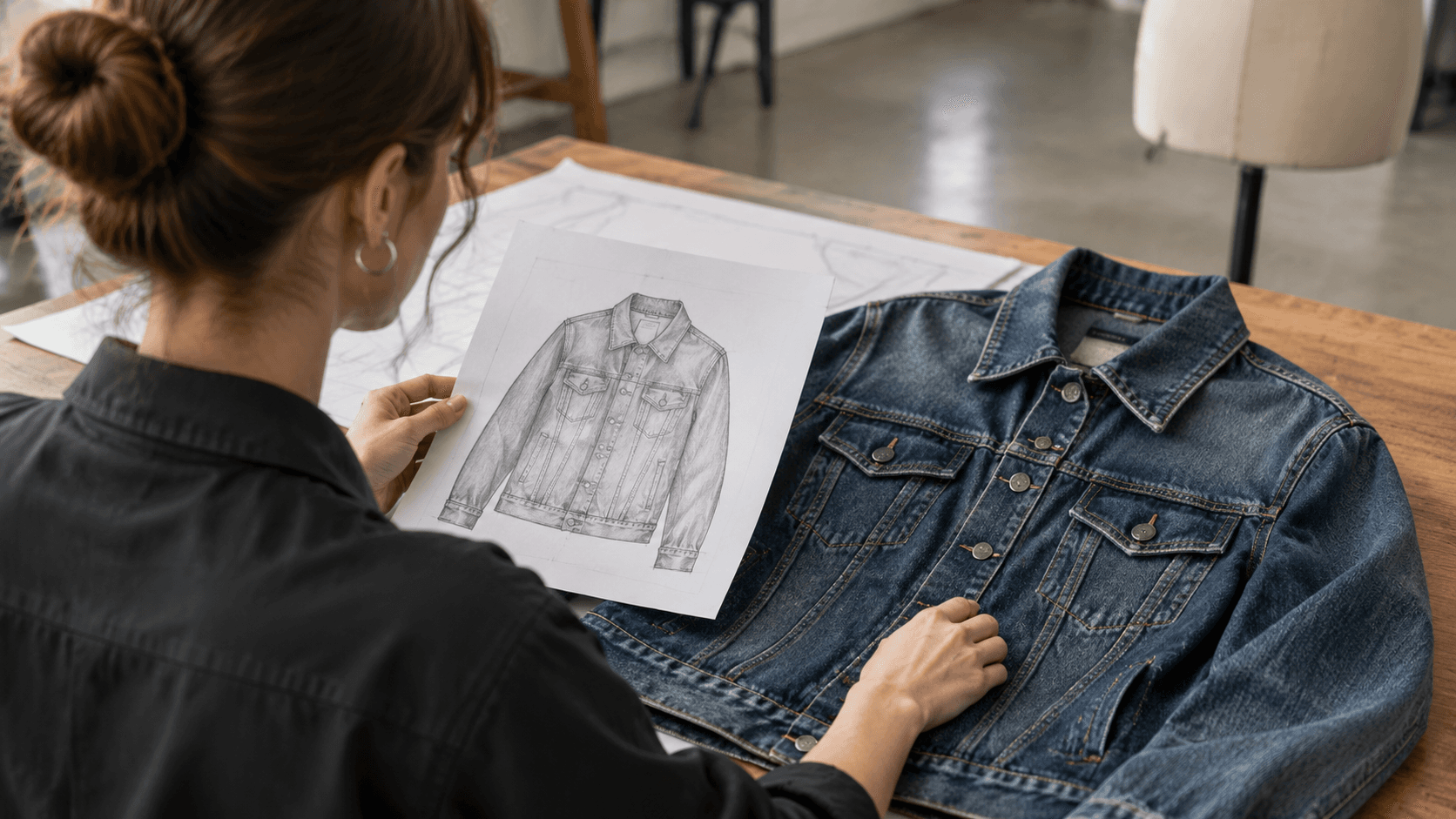
Is there a fixed MOQ number for small-batch custom denim apparel? No. What can be verified at present is this: some custom development reference styles on the website are marked with an MOQ of 30 pieces per style, while MOQs for other custom styles still need to be confirmed based on the specific plan; for available stock items, the MOQ shown on the current product detail page and ordering window applies, and some items support an MOQ of 1 piece with mixed sizes within the same style. Treating 30 pieces as a uniform commitment across all styles, fabrics, or colors will set expectations off course from the very beginning.
Where the number 30 comes from and how far it applies
This number comes from the website's labeling of certain custom development reference styles; it is not a uniform statement covering all custom plans. It is usually calculated per style, but whether it applies to a specific style, and whether the same threshold still holds after changing fabric or wash, depends on that style's development plan. Different fabrics may have different MOQ requirements, and the number of colors may also affect arrangements.
If you see a style marked with 30 pieces, you can first confirm three things: whether this quantity is calculated per style, per color, or per size; whether the original threshold still applies after changing fabric or wash; and whether piece counts from different styles can be combined. There is no uniform answer to these three points—they need to be verified style by style.
Available stock and custom are two separate paths, and MOQ rules are not interchangeable
Available stock purchasing depends on current inventory and the ordering window. The MOQ, sizes, and quantities shown on product cards are subject to what is displayed on the page and business confirmation; some items support an MOQ of 1 piece, with mixed sizes allowed within the same style. Available stock pages do not mix in custom items, and custom development reference styles do not mean there is already stock ready to ship.
When you need to change the fit, fabric, wash, or brand labels, you go through the custom communication path. In this case, the MOQ is not read from the available stock page; it is confirmed based on style, quantity, fabric, and process requirements. If you want to test the market first before deciding whether to go custom, you can start by checking sizes and quantities style by style on the available stock purchasing page, then discuss the custom plan.
How mixed sizes are calculated—don't assume piece counts from different styles can be combined
Mixed sizes within the same style is a common rule in the available stock process, but in custom scenarios, the size ratio affects fabric usage and production scheduling—whether mixing is allowed and how it works needs separate confirmation. By default, piece counts from different styles cannot be combined unless the business explicitly states otherwise.
When inquiring, writing out the size ratio clearly is more useful than just giving a total number. For example, how many pieces are expected per style and how many for each size from S to XL—this information directly affects quoting and scheduling judgments.
When quantities are small, first distinguish what can be discussed and what cannot be promised
When quantities are below the marked threshold, communication is still possible. What can be discussed: whether to develop samples first, whether to go through available stock for test sales, and whether there are other options. What cannot be directly promised: that custom arrangements can definitely be made below the threshold, that a certain price will definitely be maintained, or that delivery will definitely happen at a certain time. These all need to be confirmed based on the specific style and scheduling.
If quantities are relatively small, you can first look at available stock for test sales, or make samples first to confirm the fit and wash effect before deciding whether to proceed to bulk production. For the specific threshold of small-batch custom MOQ, refer to the verification approach in Small-Batch Custom Denim Apparel MOQ: Is 30 Pieces a Uniform Threshold? and confirm item by item per style.
What materials are needed before quoting
MOQ is only one input for a quote. To reduce back-and-forth confirmation, for the first inquiry it is recommended to provide: reference style number or product link, design drawing or reference sample, target market, expected quantity per style, color and size ratio, fabric or hand-feel requirements, wash effect, brand label and packaging requirements, target delivery date, and destination country. If the materials are incomplete, you can first send reference images and explain the details you most want to keep or adjust.
Customer service will first confirm whether it is available stock or custom, then follow up on missing items that affect the quote. Focusing on two or three key questions at a time is more effective than filling out a long questionnaire. For the overall custom development process, including requirement communication, plan confirmation, sample review, production approval, and quality inspection and shipment, you can refer to the custom denim development and private label services page to understand what needs to be confirmed at each stage.
What conclusions cannot be drawn right now
The available information does not provide a uniform MOQ for all styles, all fabrics, and all colors, nor does it explain a general rule for whether piece counts from different styles can be combined. Bulk production lead times, sampling times, and capacity scheduling all need to be confirmed based on the specific order and cannot be directly derived from the MOQ number. Whether the quote includes sample fees, trims, packaging, shipping, and taxes is also subject to the quotation.
Clarifying these boundaries first before discussing quantity and price makes it easier to get an actionable reply than asking a vague MOQ number first.