Before customizing denim garment trims and brand labels, distinguish between reference images and confirmation samples
For brands and wholesalers who often misunderstand denim garment trim and brand label customization, this outlines what information must be provided by the client, what results can only be confirmed through physical samples, and what documentation should be used as the basis for parameters such as composition and weight when selecting fabrics for custom denim shirts. Intended for buyers preparing customization inquiries who need to distinguish between reference materials and confirmation references.
Trim and label customization requires the client to provide usable artwork, dimensions, colors, placement, and quantity requirements, and to confirm trademark authorization; reference images cannot replace physical confirmation.
In this article
What a reference image can and cannot tell youWhat fields customers need to prepare for trim and label customizationDenim shirt custom fabric selection: where the parameters come fromWhy wash colors and distressed effects need sample confirmationFit and sizing: S, M, L in different markets are not directly equivalentQuotation and MOQ: first distinguish available styles from customSampling and production: every stage should have a confirmation resultWhat to prepare for a first inquiry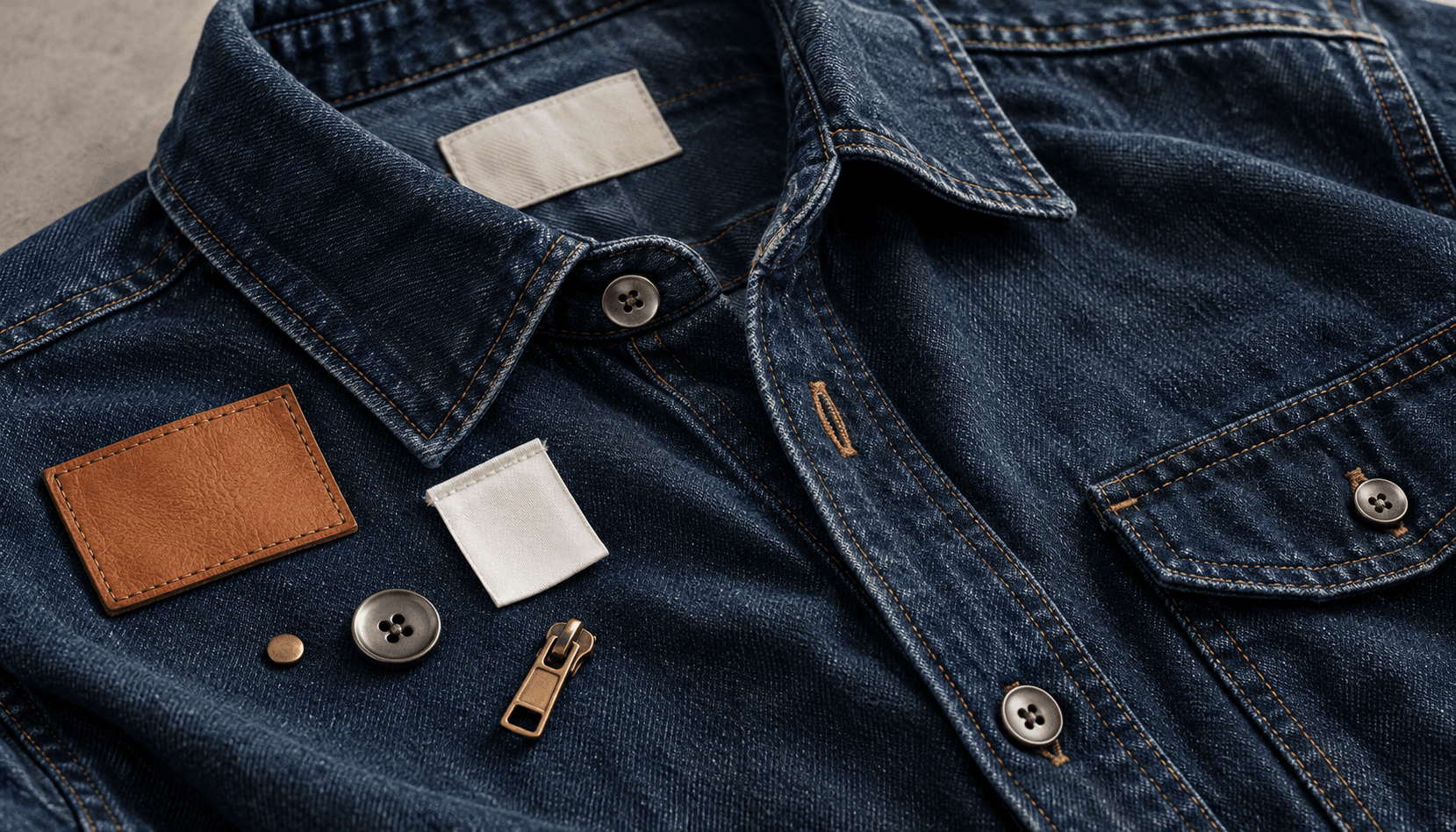
When customizing denim apparel, details such as main labels, care labels, leather patches, buttons, rivets, zippers, hangtags, and packaging are often discussed after the style and fabric. But by the time you reach the ordering stage, they are often the easiest part to get stuck on—not because the workmanship is difficult, but because "reference" and "confirmation" were not kept separate from the start.
What a reference image can and cannot tell you
A customer sends an image and says "make the trims like this"—this is a common starting point for communication. The problem is that an image can usually only identify the appearance outline, approximate color, and positional relationships. It cannot prove the actual material, dimensional tolerances, plating or coating process of the trim, nor can it indicate whether the supplier has the corresponding mold or available stock.
Model shots, flat-lay photos, and detail shots in custom product galleries are intended to help communicate style structure and design direction. These images do not prove that a physical sample, available stock, or mass production capability exists, nor can they be used to derive accurate composition and process parameters.
If a customer wants the trim effect to be close to a certain reference image, a workable approach is: mark the parts of the image you want to keep, and at the same time specify the acceptable range of variation. For example, the button shape can be referenced, but the diameter and hole spacing need to be confirmed based on the actual placket dimensions of the garment.
What fields customers need to prepare for trim and label customization
Brand label and trim customization cannot move forward just by giving a style name from one side. Customers should provide usable artwork, dimensions, colors, positions, and quantity requirements, and confirm authorization for the use of graphics and trademarks.
Specifically, missing any one of the following categories of information will lead to repeated confirmation:
- Main label: artwork file, dimensions, colors, sewing position
- Care label: composition and care information, material claims, market-specific labeling content requirements
- Leather patch: artwork, dimensions, colors, position, quantity
- Buttons/rivets/zippers: specifications, colors, surface treatment requirements, quantity
- Hangtags and packaging: artwork, dimensions, materials, quantity
Labeling information and material claims are subject to confirmed documentation. Label content for different markets needs to be verified against specific requirements; do not assume one set of labels works for all destinations.
Trims and packaging may have separate quantity, cost, and lead time requirements, which should be confirmed item by item at the time of quotation. Before confirmation, do not promise that everything is free of charge or that any quantity can be customized.
Denim shirt custom fabric selection: where the parameters come from
When selecting fabric for custom denim shirts, customers often start by discussing intended use, season, hand feel, thickness, whether they want a crisp or soft feel, and whether stretch is needed. This is a reasonable starting point, but accurate parameters such as composition, weight, yarn, and weave should come from confirmed product specifications, fabric documentation, or sample records—not from judging by photos.
For styles that need stretch, stretch, recovery, and garment fit requirements should also be confirmed; for non-stretch or crisp styles, the discussion should also factor in range of motion and size design. Fabric substitution may affect color, wash, hand feel, and garment dimensions; after any change, the sample should be re-verified rather than directly treated as an equivalent replacement.
If the customer only has reference images, they can first describe the details they most want to keep or adjust, and the sales team will verify development feasibility, materials, processes, pricing, and scheduling before proceeding with samples.
Why wash colors and distressed effects need sample confirmation
Customers can provide target color swatches, reference garments, or clear images, and specify light/dark tones, whiskering, grinding, holes, fraying, or other treatment requirements. Reference images are affected by lighting and screens and cannot serve as an absolute color difference standard.
With different fabrics and structures, the same treatment may produce different hand feels and colors. Effects should be confirmed through samples, with key positions and details to be preserved recorded. Do not promise zero color difference, absolute colorfastness, or unverified eco-friendly processes. When testing or special standards are required, the requirements and verification methods should be clearly specified during the development stage.
Fit and sizing: S, M, L in different markets are not directly equivalent
Customers need to provide a size chart or key measurement points for the target market, such as waist, hip, front and back rise, inseam, thigh, and leg opening; for tops and dresses, the corresponding measurement points should be completed according to the specific structure. S, M, L labels in different markets cannot be directly treated as the same size.
During sampling, verify the measurement method, size units, pre-wash or post-wash state, and allowable tolerances, and record fitting feedback when necessary. Bulk production uses the specification version confirmed by both parties; do not infer the fit of all sizes based solely on a model's body shape.
Quotation and MOQ: first distinguish available styles from custom
Quotation discussions need to factor in style, quantity, fabric, wash, trims, brand customization, packaging, and delivery requirements. The range prices and tiered prices on available-style pages are not the lowest price applicable to any quantity; they should be verified based on the combined quantity of the same style and the current specifications. Custom items are quoted based on requirements and do not follow available-style pricing.
Some custom development reference styles on the website indicate an MOQ of 30 pieces per style; MOQs for other custom styles still need to be confirmed based on the plan, and 30 pieces must not be treated as a uniform commitment for all styles, fabrics, or colors. For available styles, the MOQ shown on the current detail page and ordering window applies; some items support a 1-piece minimum and mixed sizes within the same style. Verify whether the MOQ rule is calculated by style, color, or size, and do not default to combining quantities across different styles.
If the quantity is small, you can first discuss available styles for test sales or sample development, then verify whether customization can be arranged. For available-style purchasing, you can check the available denim purchasing page to verify sizing, quantity, stock, and shipping arrangements style by style; when you need to change the fit, fabric, wash, trims, or brand labels, move to the denim custom development and private label services discussion.
Sampling and production: every stage should have a confirmation result
Custom development typically goes through several stages: communicating requirements, confirming the plan, sampling and review, approving the sample and production, and quality inspection, packaging, and shipping. Each stage should have a clear confirmation result, and after revisions the latest version should be synchronized to avoid inconsistency between drawings, samples, and orders.
Sample approval means both parties have established the production reference; it does not mean that details the customer has not confirmed can be decided by the factory on its own. Sample fees, revision rounds, and shipping arrangements are subject to the project agreement.
The person in charge states sampling takes 3 days, bulk production ships within 30 days depending on volume, and available styles ship the same day. These are capabilities and arrangements that need to be confirmed against the specific order and cannot be guaranteed to apply unconditionally to all styles. The confirmation milestone from which lead time is counted still needs to be written into the order; shipping does not equal arrival, and transit and customs clearance time are calculated separately.
What to prepare for a first inquiry
To reduce back-and-forth confirmation, a first inquiry should ideally include: reference style number or product link, design drawings or reference samples, target market and men's/women's positioning, estimated quantity per style, color and size breakdown, fabric or hand feel requirements, wash effects, brand label and packaging requirements, target lead time, and destination country.
If the information is incomplete, you can start by sending reference images and describing the details you most want to keep or adjust. Customer service will first confirm whether it is available style or custom, then follow up on the missing items that affect pricing; focus on two or three key questions at a time rather than holding customers back with a lengthy questionnaire. The next step is to form a requirement description that can be quoted.
Real footage from the factory's production and washing stages can be used to illustrate actual production processes such as sewing, washing, and fabric preparation; for details, see the denim manufacturing process. Whichever stage is shown should correspond to real footage from that stage; equipment counts, factory area, employee numbers, third-party certifications, and customer lists that are not confirmed in existing materials must not be added on your own.