
How to confirm denim sample revisions: check whether comments land on verifiable parts
Disputes over sample revisions often arise when comments don't land on specific parts. From a buyer's perspective, this article explains how to turn feedback on fit, measurements, wash, and trims into verifiable revision records, distinguish must-change items from acceptable differences, and provides observation points for review. Suitable for brands and wholesalers who need to review samples and control rework rounds.
When confirming revisions, turn verbal comments into written records with part, direction, target effect, and version number, and review item by item against the approved sample.
In this article
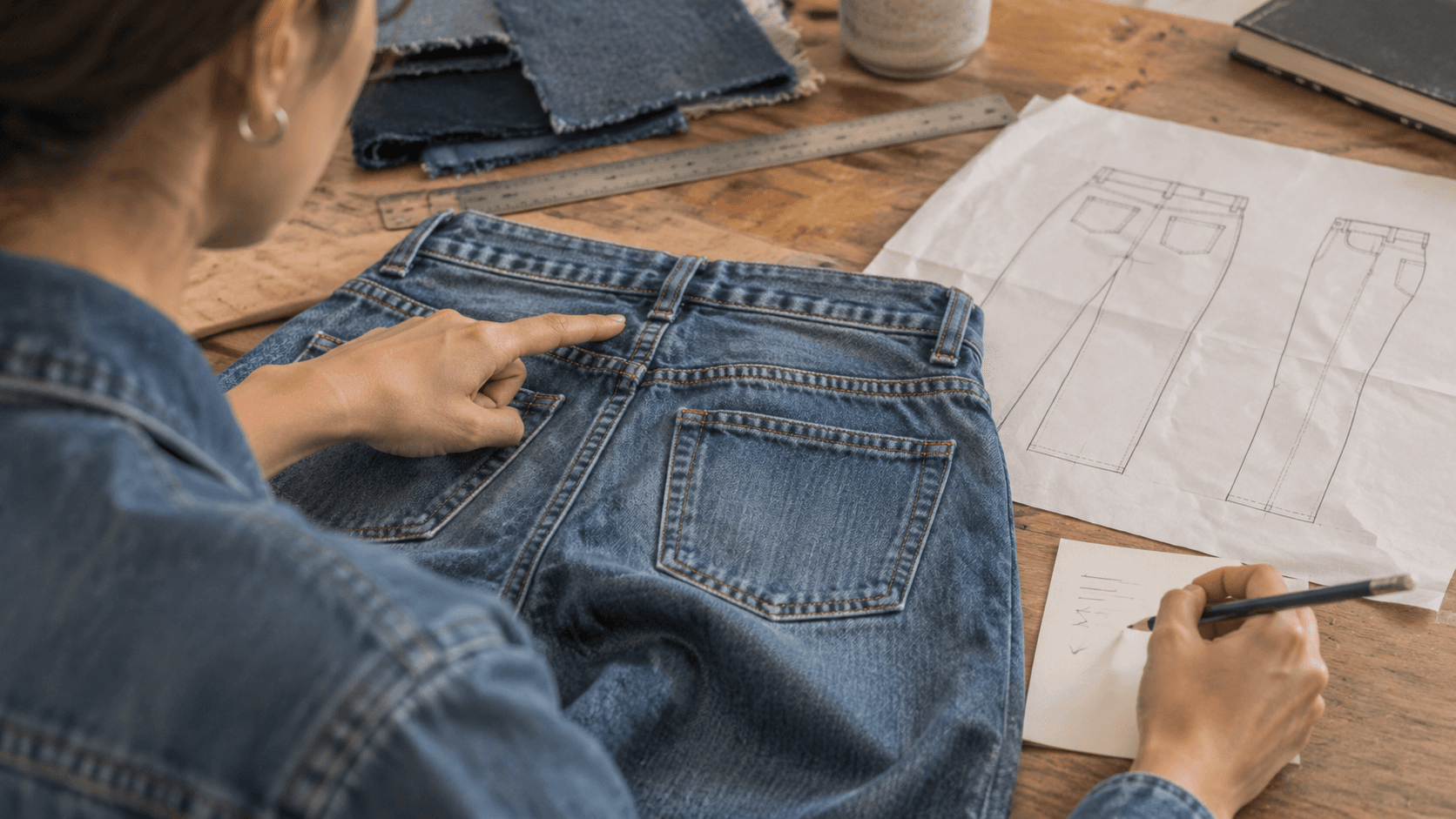
After receiving a sample, saying "take in the waist a bit" or "make the wash a bit bluer" may still leave the next round of samples mismatched. The problem is often not that the factory did not make changes, but that the revision comments were not tied to checkable parts and values. The key to confirming denim sample revisions is to make every comment correspond to a specific location, direction, and target effect, rather than remaining at the level of subjective description.
Turn verbal comments into part descriptions first
"The fit is wrong" cannot be executed, but "the back waistband curve is about 1 cm lower than the reference sample" can be checked. When giving feedback, write at least three things clearly: which part, in which direction to change it, and to what extent. Use part names that both sides recognize, such as front rise, back yoke, side seam, leg opening, and pocket opening position. Use action words for direction such as "widen/narrow, raise/lower, deepen/sharpen." If a value can be written for the extent, write it; if there is no value yet, attach a close-up photo marked with the part and explain which details should be kept and which should be adjusted.
For size issues, specify the measuring method. Is the waist measured along the waistband or along the waist opening curve, is the inseam measured from the side seam or from the front center, and is it before or after washing? If these are not stated clearly, the same set of numbers may lead to different conclusions. Units should also be consistent to avoid mixing centimeters and inches.
Revision records must be traceable by version
Keep a version number for each round of revisions, for example V1 initial sample, V2 first revision, V3 second revision. In the record, clearly state which parts were changed in this round, which were not changed, and which are to be discussed in the next round. Do not use vague wording such as "revised according to last comments," because last comments may be scattered across chat records, emails, and verbal communication, and different people may understand them differently.
Separate must-change items from acceptable differences. Must-change items are issues that affect wearing, dimensions, or key design points; acceptable differences are ranges allowed at the sample stage, such as fabric hand feel and slight variations in wash depth. Recording them separately can prevent repeated back-and-forth on the same point every round.
List wash and trim revisions separately
Wash effects are affected by fabric, construction, and lighting, and the same treatment may appear differently on different fabrics. When giving wash feedback, point out key locations, such as whisker direction, the extent of bleaching, and treatment of damaged edges, and explain which details need to be retained. Reference images are affected by screens and lighting and cannot be used as an absolute color-difference standard; final confirmation is based on the sample.
Revisions to trims and labels must also be tied to location and specifications. Write clearly item by item: main label position, care label content, leather patch size, and button color. When trademarks or graphics are involved, confirm whether authorization materials are complete.
Refer to the approved sample during review
When the revised sample arrives, do not look only at the places that were changed. Put this round's revision record together with the previously approved sample and check item by item: whether the changed parts achieve the target effect, whether unchanged parts were accidentally affected, and whether dimensions were measured in the agreed way. If deviations are found, record the style number, part, photos, and measurement results, then confirm the handling plan with the business team.
Sample approval means both sides have determined the production reference, but it does not mean that unconfirmed details can be decided by the factory on its own. After each round of revisions, synchronize the latest version to avoid inconsistency among drawings, samples, and orders. To understand how revision records connect with the sampling process, see How to confirm denim sample revisions: turn verbal comments into checkable revision records; for confirmation milestones at each stage of custom development, see custom denim development and OEM/ODM services.
One practical review point
Before the next sample review, first list the revision comments by part in a table, with each row stating: part, revision direction, target effect, whether it is a must-change item, and corresponding version number. During the review, check each row off or mark it as not achieved. This table makes omissions easier to spot than a paragraph of description and also facilitates later bulk production checks.