
Denim Size Charts and Tolerances: Don't Treat Reference Images as an Inspection Checklist
When developing custom denim, product galleries and reference images are only for communicating style direction and cannot serve as the basis for size or construction parameters. Buyers need to provide a size chart or key measurement points according to the target market, and clearly specify the measuring method, units, pre-wash/post-wash state, and allowable tolerances. A denim garment quality inspection checklist should be checked item by item against the approved sample and confirmed specifications, rather than relying on images for judgment. This article is aimed at brands and buyers, explaining the practical use of size charts and tolerances in purchasing confirmation.
Reference images can only show appearance and cannot replace size chart and tolerance confirmation; inspection should be based on the approved sample and the specification version confirmed by both parties, with measuring method, units, and pre-wash/post-wash state specified item by item.
In this article
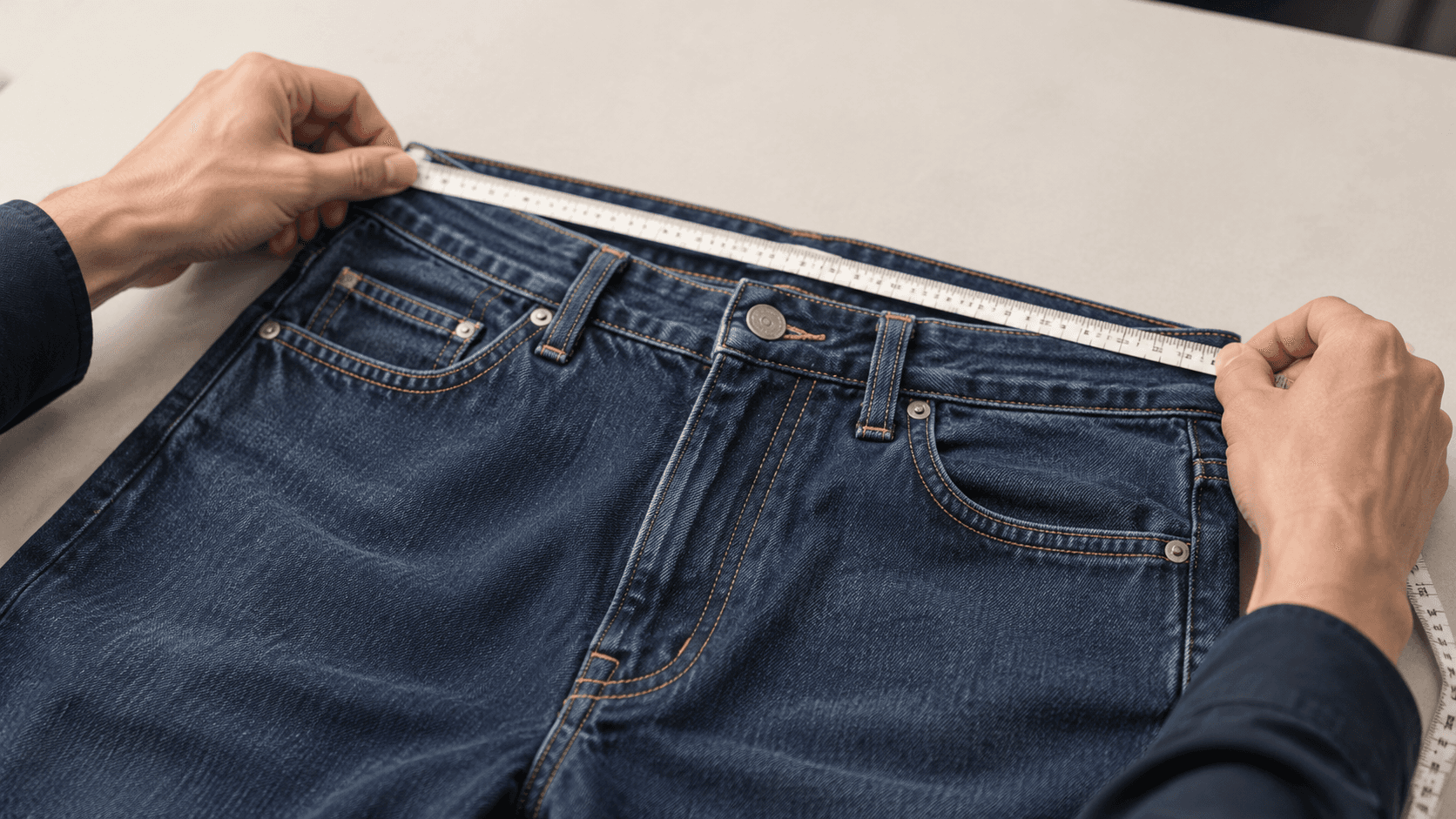
Seeing a reference image with a great silhouette, the first reaction is often "just make it like this." But a reference image can only convey the visual outline and design direction—how long the inseam is, how many centimeters of tolerance to allow on the waist, how much the dimensions will shift after washing—none of that information exists in the image. Treating a reference image directly as the acceptance criteria is a common confusion in custom communication.
What a reference image can and cannot answer
The custom product gallery includes front and back model shots, flat-lay front and back shots, and detail images, intended to help customers communicate style structure and design direction. Generated or displayed reference images do not prove that a physical sample exists, that stock is available, that real customers exist, or that mass production capability exists, nor can they be used to derive accurate composition and process parameters. When customers ask about the final finished product result, they should be guided to confirm the sample garment, color, dimensions, and process records. Image display cannot replace formal specifications and sample confirmation.
In other words, reference images address "does it look right," while size charts and tolerances address "will it fit right." The two cannot substitute for each other.
Size charts must specify measurement methods, not just numbers
Customers need to provide size charts or key measurement points according to the target market, such as waist, hip, front and back rise, inseam, thigh, and leg opening; for tops and dresses, the corresponding measurement points should be completed according to the specific structure. S, M, L labels in different markets cannot be directly treated as the same size.
During sampling, verify the measurement method, size unit, pre-wash or post-wash state, and allowable tolerance, and record fitting feedback when necessary. Mass production uses the specification version confirmed by both parties; the wearing effect of all sizes cannot be inferred solely from the model's body shape.
Here is a detail that is easily skipped: the measurement method. Whether the waist is measured along the inner edge or outer edge of the waistband, whether the inseam is measured from the top of the waistband or from the crotch seam, and how the start and end points of the front and back rise are defined—different approaches can produce numbers that differ by a noticeable amount. If a size chart gives only numbers without measurement definitions, it is easy for each party to interpret things differently during sampling.
Tolerance is not "close enough"—it is the allowable range written into the specification
Tolerance refers to the allowable range of dimensional variation. It needs to be written into the confirmed specification together with the measurement method, unit, and pre-wash/post-wash state, rather than agreed verbally as "don't be too far off." Denim fabric may change dimensions after washing; measurements taken before washing and after washing yield different values, and the confirmed specification should state which state is the reference.
Fabric substitution may affect color, wash, hand feel, and garment dimensions. After a change, the sample garment should be re-checked and not directly treated as an equivalent substitute. If the fabric is changed or the wash formula is modified during development, the original size chart needs to be re-verified against the sample garment and cannot be assumed to carry over.
The starting point of the acceptance checklist is the approved sample, not the image
Before placing an order, the inspection requirements for garment dimensions, appearance, color difference, stitching, trims, and packaging should be clarified, with the approved sample and confirmed specifications as the basis for verification. If customers require a specified sampling plan, third-party inspection, or test reports, they should raise this in advance to confirm arrangements, costs, and responsibilities. No AQL level, inspection pass rate, or certification can be promised without documentation. When deviations are found, record the style number, quantity, photos, and measurement results, and confirm the handling plan with the business team.
During the sample review stage, it is recommended to consolidate feedback on silhouette, dimensions, fabric hand feel, color and wash, stitching, trims, and label placement in one round, annotating areas with photos and stating the target effect. Distinguish between must-change items and acceptable differences to avoid conflicting verbal opinions across multiple rounds. Keep version numbers and confirmation records for each round of changes; when materials or structure change, re-check costs and timing at the same time. Sample approval means both parties have established the production reference—it does not mean that details the customer has not confirmed can be decided by the factory on its own.
If the order involves replenishment or repeat orders, dimension verification should also distinguish between the different paths of stock replenishment and custom repeat orders. Refer to the verification items in Reorder Size Mismatch: Stock Replenishment vs. Custom Repeat Orders—What to Check First.
An actionable review step
Place the reference image, size chart, tolerance notes, and approved sample side by side for comparison: does every area marked on the image have a corresponding measurement point and value in the size chart; do the values specify the measurement method, unit, and pre-wash/post-wash state; does the tolerance range fall within the confirmed specification. Whichever item is missing, fill it in before sampling—rather than waiting until mass production comes out and then comparing against the image.
The confirmation milestones at each stage of custom development can be understood in conjunction with the communication scope of custom denim development and private label services, but the specific dimensions and tolerances remain subject to the specification version confirmed for that project.