
Jeans Size Charts and Tolerances: Balancing In-Stock Verification and Custom Confirmation
When sourcing jeans, how you verify size charts and tolerances depends on whether you are buying available styles or going custom. For available styles, the current product page and order window are authoritative—focus on size labeling and pre-wash/post-wash states. For custom development, the customer provides the target-market size chart and key measurement points; measurement methods, units, and tolerances are confirmed at the sampling stage, with the approved sample and spec version serving as the basis for bulk production. The two paths have different documentation boundaries and cannot substitute for each other.
For available styles, check the current product page and order window; for custom, provide a size chart per the target market and confirm pre-wash/post-wash states. Tolerance ranges must be written into the confirmed version—never inferred from a single sample garment.
In this article
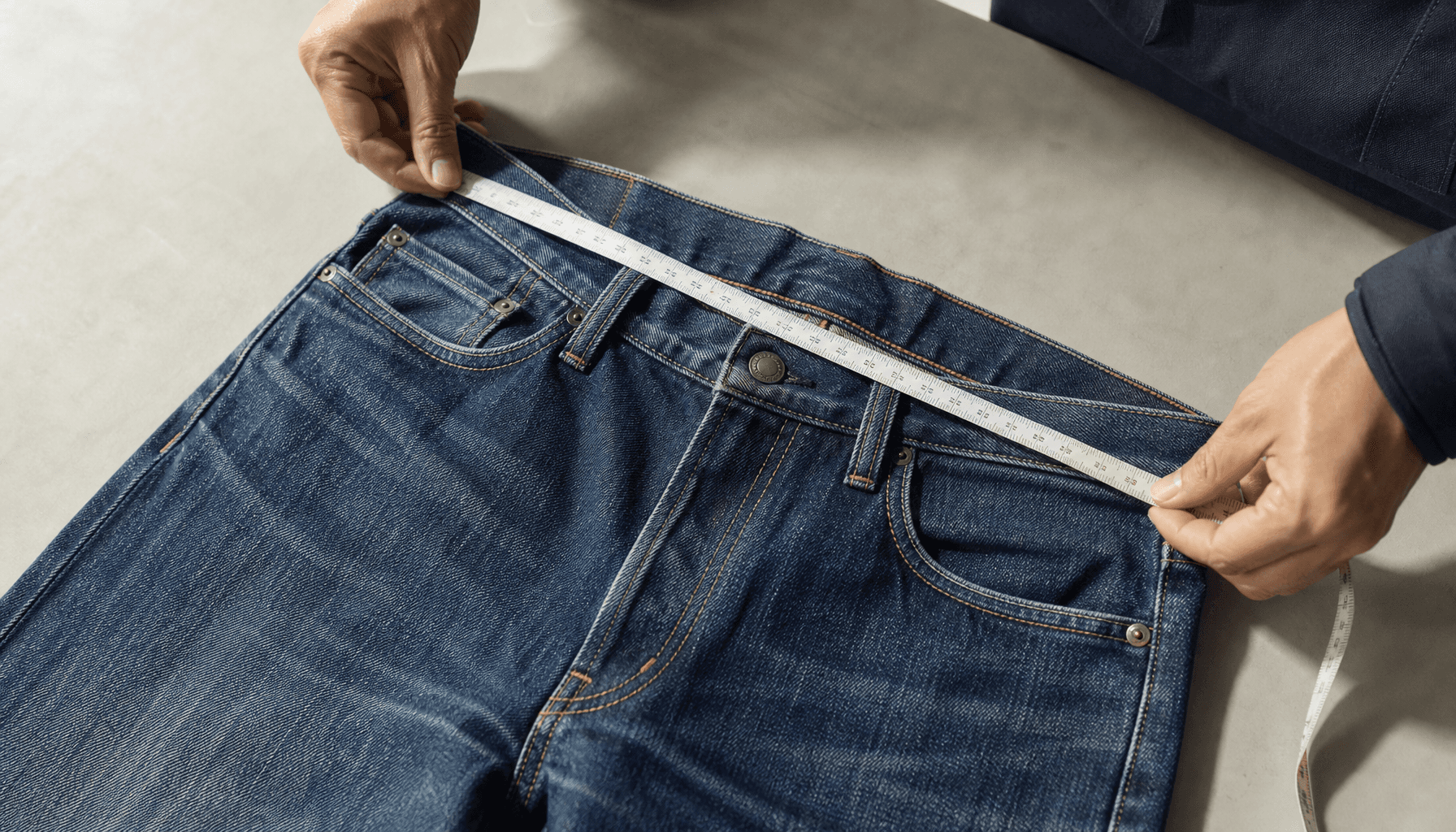
When purchasing jeans, people often treat the size chart on an available styles page as the sizing basis for custom development, or conversely, use single-piece measurements from a custom sample to infer that every piece in bulk production will fall within the same range. Both approaches skip the same premise: size charts and tolerances must correspond to a specific supply path and confirmation stage.
First, distinguish the sizing data sources of the two paths
For available styles purchasing, sizing information is based on what is currently shown on the product detail page and ordering window. The size labels, available sizes, and minimum order rules on the page need to be checked item by item before placing an order. Some available styles support mixed sizes within the same style, but the specific rules are executed according to the current ordering window and business confirmation results; the knowledge base does not store fixed inventory numbers or long-term valid size commitments.
Custom development has a different sizing source. Customers need to provide a size chart or key body measurements according to the target market, such as waist, hip, front rise, back rise, inseam, thigh, and leg opening; for tops and dresses, the corresponding measurement points should be added according to the specific structure. S, M, and L labels in different markets cannot be directly regarded as the same size, and this applies to both men's and women's denim categories.
| Check item | Available styles | Custom |
|---|---|---|
| Source of size chart | Current product page and ordering window | Customer provides size chart according to target market |
| Key measurements | Check the sizes marked on the page | Waist, hip, front rise, back rise, inseam, thigh, leg opening, etc. listed item by item |
| Measurement state | Subject to the page description | Confirm pre-wash or post-wash state during sampling |
| Tolerance | According to the current page and order agreement | Confirmed at the sampling stage and written into the specification version |
| Basis for bulk production | Current order and settlement information | Approved sample and the specification version confirmed by both parties |
Tolerances should be discussed at the sampling stage, not added after bulk production
Under the custom path, in addition to checking the measurement method, size unit, and pre-wash or post-wash state during sampling, the allowable tolerance also needs to be confirmed. Tolerance is not better when tighter; it should be considered together with fabric characteristics, washing process, and garment structure. For styles requiring stretch, stretch, recovery, and garment fit requirements should also be confirmed; for non-stretch or structured styles, the discussion should also consider ease of movement and size design. Fabric substitution may affect color, wash, hand feel, and garment dimensions; after changes, the sample should be rechecked and not directly regarded as an equivalent replacement.
During sample review, it is recommended to consolidate feedback on fit, dimensions, fabric hand feel, color and wash, stitching, trims, and label placement in one round, mark the areas with photos, and state the target effect in writing. Distinguish between must-change items and acceptable differences, and keep version numbers and confirmation records for each round of changes. Sample approval means both parties have determined the production reference; it does not mean that details not confirmed by the customer can be decided by the factory on its own.
Measurement method and unit: writing them clearly matters more than writing more
If the numbers on a size chart lack measurement definitions, execution can easily lead to different interpretations. Whether waist is measured on the inner or outer circumference, whether inseam is measured from the waistband to the leg opening or from the crotch seam, and which position is used for thigh measurement all need to be specified in the specifications. Units must also be consistent; centimeters and inches cannot be mixed. Bulk production uses the specification version confirmed by both parties, and the wearing effect of all sizes cannot be inferred solely from a model's body shape.
For the distinction between pre-wash and post-wash states, please refer to Jeans Size Charts and Tolerances: First Distinguish Pre-Wash and Post-Wash During Checks; if both available styles and custom paths are involved, there is a more detailed comparison of the key checking differences between available styles and custom.
Batch consistency depends on the confirmed version, not a single sample
Before placing an order, inspection requirements for garment dimensions, appearance, color difference, stitching, trims, and packaging should be clarified, with the approved sample and confirmed specifications used as the checking basis. If the customer needs a specified sampling plan, third-party inspection, or test report, this should be raised in advance to confirm arrangements, costs, and responsibilities. An AQL level or inspection pass rate cannot be promised when no information is available. When deviations are found, record the style number, quantity, photos, and measurement results, and confirm the handling plan with the business team.
Available styles and custom differ in how size charts and tolerances are checked, and the choice depends on whether this purchase continues an existing style or develops according to brand requirements. If the style requires adjustments to fit, fabric, or wash, you can proceed to custom denim development and private label services to discuss the plan; if you first need to check the sizes and available quantities of existing styles, review them style by style through available denim purchasing. Whichever path is taken, the tolerance range should be documented in a written confirmed version, not left verbal or based on a single sample.