
Men's denim fit development: why the approval checklist comes before the quotation
A sourcing guide for brands and wholesalers: in men's denim fit development, define key measurement points, wash effects and trim placements first to create a verifiable approval checklist, then move on to quoting and sampling. Intended for readers who need custom development or repeat orders; for available stock, check the product page separately.
Write the approval checklist during fit development: put waist, hip, front/back rise, inseam, thigh, leg opening, wash placement and tolerances into the spec before discussing pricing to reduce sampling rework. Field order: title, summary, metaTitle, metaDescription, tldr; SEO fields must be independently concise.
In this article
Define measurement points first in fit development, not S/M/LWrite wash effects into the checklist—don't just say "medium blue"Trims and label positions—visible at acceptanceBefore the quotation, what the acceptance checklist must answerSample review and revision recordsAt bulk acceptance, return to the same checklistCheck custom and available-stock paths separately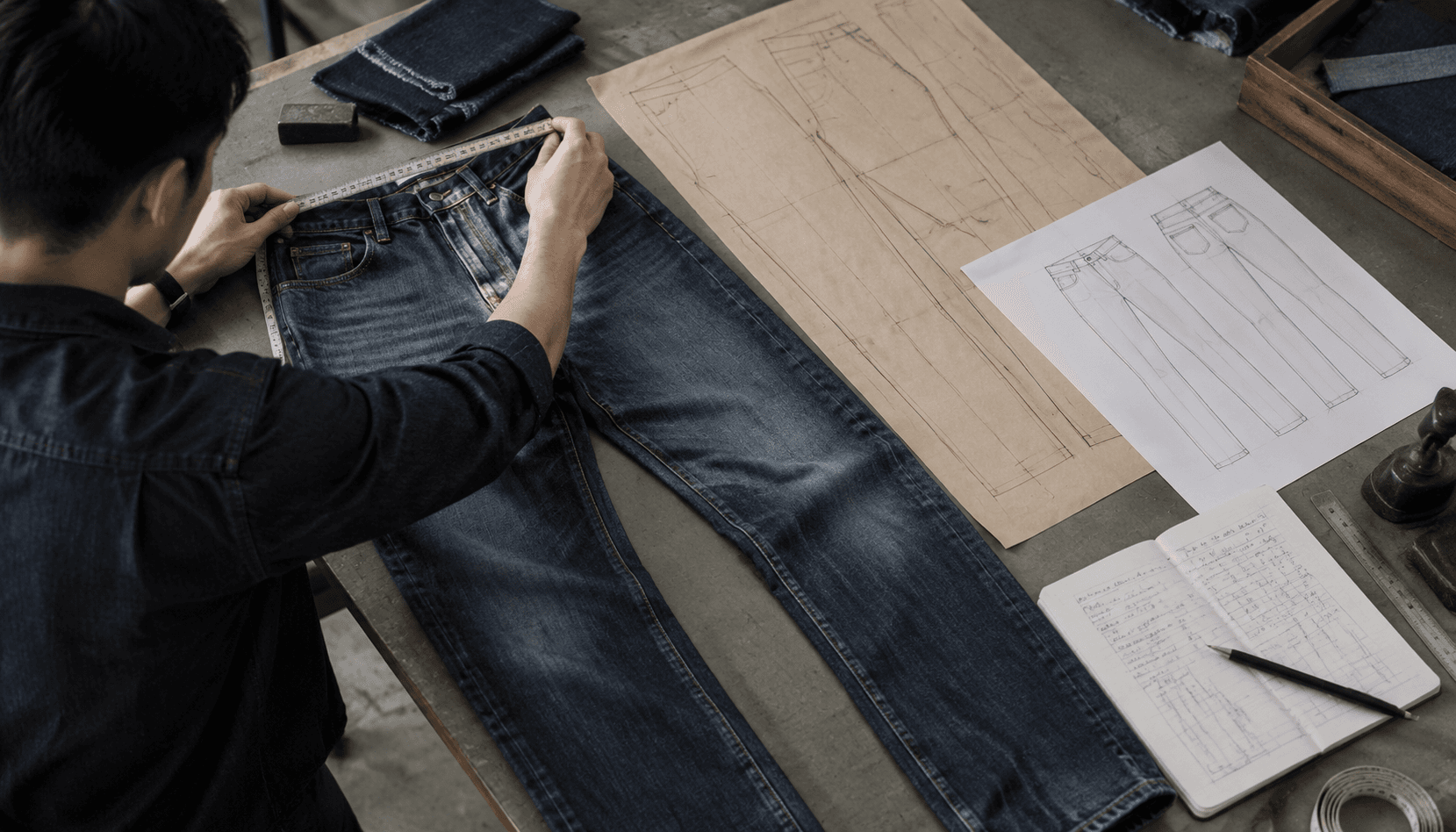
For men's denim fit development, having an acceptance checklist before the quotation often saves more trouble than comparing prices first. The reason is simple: if the fit, measurements, wash effects, and trim placements are not written down as verifiable conditions, quotations can only be estimated based on approximate styles, and post-sampling revisions easily lead to differing interpretations.
Define measurement points first in fit development, not S/M/L
Fit differences in men's denim usually come down to the waist, hip, front and back rise, inseam, thigh, and leg opening. When customers provide size charts or key measurement specs for their target market, they should also specify the measuring method, units, and whether measurements are taken before or after washing. S, M, L across different markets cannot be treated as identical sizes; sampling should be checked against the confirmed spec version, and the fit of all sizes should not be inferred solely from a model's body shape.
A practical approach: in the spec sheet, give each key measurement three columns—target value, acceptable tolerance, and measuring method. For example, whether the waist is measured along the top edge of the waistband or along the curve, and whether the inseam is measured from waistband to hem or from crotch seam to hem—once these are clearly stated, there is a common language during sample review.
Write wash effects into the checklist—don't just say "medium blue"
Wash colors and distressed effects are affected by lighting and screens; reference images cannot serve as an absolute color difference standard. Customers can provide target color swatches, reference garments, or clear images, specify light/dark shades, whiskers, grinding, holes, fraying, or other treatment requirements, and record key positions and details to be preserved. Different fabrics and constructions may produce different hand feel and color from the same treatment, so effects need to be confirmed through samples.
The acceptance checklist can be written like this: which pocket the whiskers are near, which seam the grinding extends to, the size of holes and how fraying is treated. Do not promise zero color difference or absolute colorfastness; when testing or special standards are needed, specify requirements and verification methods during the development stage.
Trims and label positions—visible at acceptance
Brand details may include main labels, care labels, leather patches, buttons, rivets, zippers, hangtags, and packaging. Customers should provide usable artwork, dimensions, colors, positions, and quantity requirements, and confirm authorization for graphics and trademark use. In the acceptance checklist, trim positions should be written down to specific locations—for example, whether the main label is centered or offset inside the waistband, and where the leather patch sits on the back waist. Label information and material declarations are based on confirmed documents; label content for different markets needs to be checked against specific requirements.
Before the quotation, what the acceptance checklist must answer
Quotation communication needs to cover style, quantity, fabric, wash, trims, brand customization, packaging, and delivery requirements. Range prices and tiered prices on available-stock pages are not the lowest prices applicable to any quantity; custom products are quoted per requirements and do not reuse stock prices. When comparing quotations, confirm whether sample fees, trims, packaging, shipping, taxes, and other services are included.
The acceptance checklist should at minimum answer: are key measurement specs and tolerances clearly defined, are key wash positions marked, are trim and label positions confirmed, and are packaging requirements written in. Once these conditions are in place, quotations and sampling schedules have a basis. Some website custom development reference styles indicate a minimum of 30 pieces per style; MOQs for other custom styles still need to be confirmed per proposal—30 pieces cannot be treated as a uniform commitment for all styles, fabrics, or colors.
Sample review and revision records
Upon receiving samples, it is recommended to consolidate feedback on fit, measurements, fabric hand feel, color and wash, stitching, trims, and label positions in one go, annotating areas with photos and stating the target effect. Distinguish between must-change items and acceptable differences to avoid conflicting verbal comments across multiple rounds. Keep version numbers and confirmation records for each revision round; when materials or construction change, recheck costs and timing at the same time.
Sample approval means both parties have established the production reference—it does not mean details not confirmed by the customer can be decided by the factory. Sample fees, revision rounds, and shipping arrangements are subject to project agreements.
At bulk acceptance, return to the same checklist
Before placing an order, inspection requirements for garment measurements, appearance, color difference, stitching, trims, and packaging should be clearly defined, using approved samples and confirmed specs as the verification basis. If customers require specified sampling plans, third-party inspection, or test reports, these should be raised in advance, with arrangements, costs, and responsibilities confirmed. When deviations are found, record the style number, quantity, photos, and measurement results, and confirm the resolution with the business contact.
Inspection recommendations do not mean ZHIZHI has obtained any particular testing certification; no AQL level or inspection pass rate should be promised without documentation.
Check custom and available-stock paths separately
When customers want quick replenishment or to test the market first, they should check the available-stock purchasing page and verify sizes, quantities, stock, and shipping arrangements style by style; when they want to change fit, fabric, wash, trims, or brand labels, they should move to the custom denim development and private label service discussion. Available-stock pages do not mix in custom products; custom products display reference designs and do not represent stocked inventory.
The factory capacity figure of 300,000 pieces corresponds to monthly capacity in historical communications; before formally using the monthly figure with customers, the business team should reconfirm the statistical scope and current available scheduling. 3-day sampling, delivery within 30 days for bulk orders depending on volume, and same-day shipping for stock items are capabilities and arrangements that need to be confirmed against specific orders—they cannot be guaranteed as unconditionally applicable to all styles. The confirmation milestone from which lead time is counted still needs to be written into the order; shipping does not equal arrival—transit and customs clearance times are calculated separately.
Writing the acceptance checklist in detail during the fit development stage gives quotations and sampling a comparable foundation. The next step: take an existing spec sheet, fill in each gap item by item according to the measurement points, wash positions, and trim positions above, then hand it to the business team for confirmation.