Custom Trims and Label Development: Check These Three Boundaries Before Small-Volume MOQ
A sourcing checklist guide for brands and buyers: denim garment trims and brand label development are often asked about as one package, but main labels, care labels, leather patches, buttons, hangtags, and packaging each have independent quantity, cost, and lead-time rules. This article covers three boundaries—MOQ calculation basis, artwork and authorization, and label content verification—explaining what unit to use when confirming small-volume custom MOQs and which items must be confirmed before sample approval.
Before confirming whether custom trims and labels can be made, clarify three things: whether main labels, care labels, and leather patches are each subject to separate MOQs, whether the 30-piece-per-style minimum applies to trims, and whether artwork authorization and placement confirmation are completed before sampling. Field order: title, summary, metaTitle, metaDescription, tldr; SEO fields must be independently condensed.
In this article
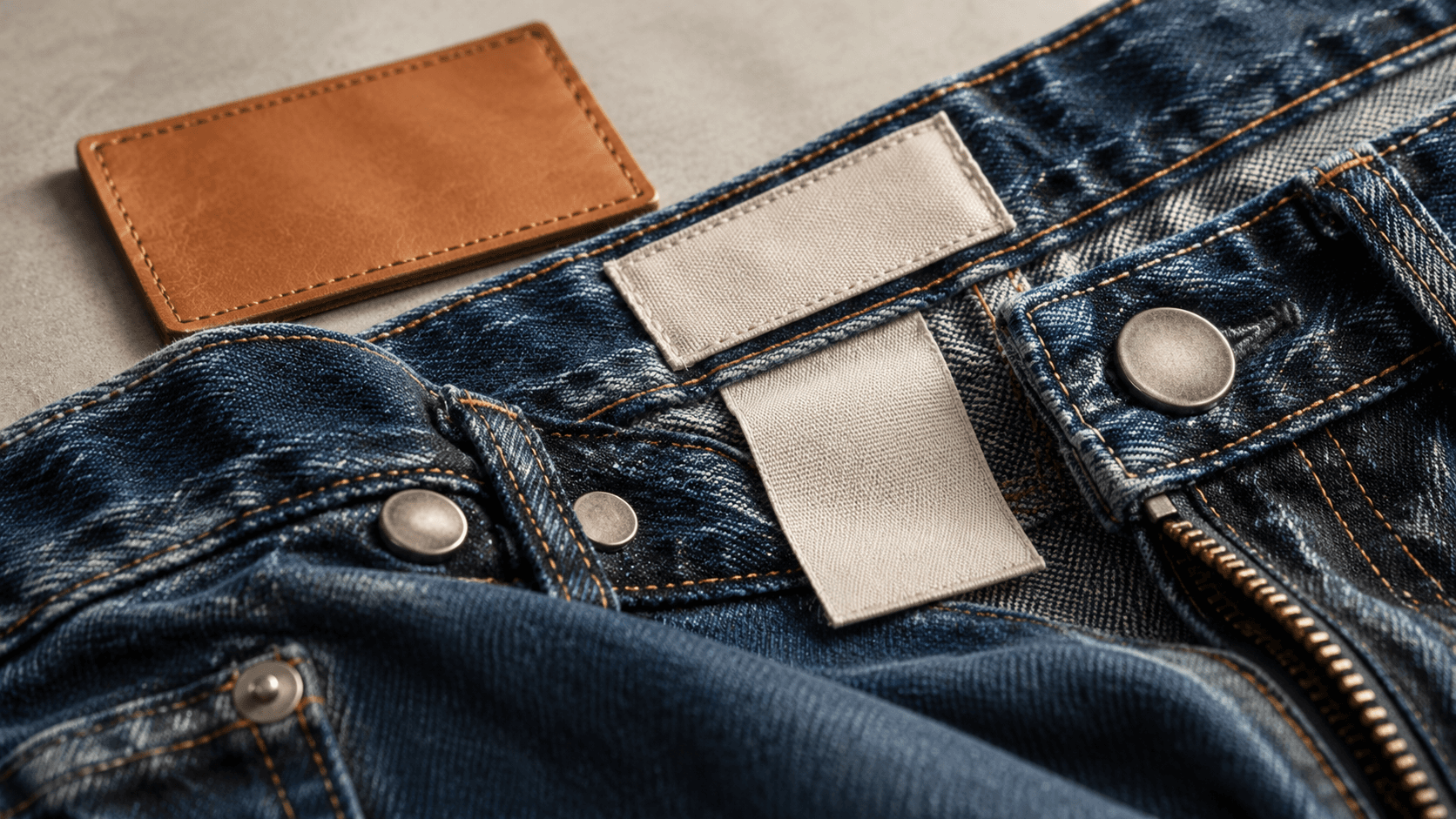
When asking about trims and label customization, the easiest answer to get is "we can do it." But what really affects pricing and scheduling are three unclear boundaries behind that sentence: what unit MOQ is calculated by, at what point artwork and authorization count as confirmed, and who verifies label content.
MOQ is not one shared number for all trims
MOQ for small-batch denim customization is often understood as a single number, but it actually needs to be broken down. The 30 pieces per style MOQ mentioned in the knowledge base is an indication for some custom development reference styles on the website, not a uniform commitment for all styles, fabrics, colors, and trims. Trims and packaging may have independent quantity, cost, and lead time requirements, which should be confirmed item by item at the quotation stage.
When checking specifics, first clarify whether the MOQ rule is calculated by style, by color, or by size, and whether piece counts for different styles are combined by default. Main labels, care labels, leather patches, buttons, rivets, zippers, hang tags, and packaging may each have their own threshold. If trim MOQ is understood only in terms of garment piece counts, the quotation stage can easily produce a gap where "garment quantity is sufficient but trim quantity is not."
For smaller quantities, you can first discuss available styles for test sales or sample development, then verify whether trims can be arranged with that batch. Whether mixed sizes, mixed colors, and mixed trims are supported needs to be confirmed by the business team under current conditions and cannot be inferred directly from reference style pages.
Artwork, authorization, and placement: confirm before sampling
Customers should provide usable artwork, dimensions, colors, placement, and quantity requirements, and confirm authorization for pattern and trademark use. Among these, artwork and authorization are often glossed over in one sentence, but they are actually two independent confirmation tracks.
Artwork determines what the finished product looks like; authorization determines whether it can be used. Label information and material declarations are subject to confirmed materials, and label content for different markets needs to be verified against specific requirements. Reference images can indicate design direction but cannot replace formal specifications, nor can they be used to derive accurate composition and process parameters.
Placement and dimensions must also be locked into confirmed pieces. Where the main label is sewn, what size the leather patch is, how many lines the care label content runs to—these are often unclear on reference images. It is recommended to annotate locations with photos and specify the target effect, separate must-change items from acceptable differences, and avoid conflicting verbal feedback across multiple rounds. Keep version numbers and confirmation records for each round of changes; when materials or construction change, recheck costs and timing at the same time.
For the confirmation rhythm of trims and labels, refer to Denim Trims and Brand Label Customization: first distinguish reference images from confirmed pieces as described in that article, and handle "looking at images" and "confirmed pieces" separately.
Label content: who verifies, and against what
Composition, country of origin, and care instructions on care labels, brand information on leather patches, and size and price on hang tags—once these are printed incorrectly, rework costs exceed the trims themselves. The boundary in the knowledge base is: label information and material declarations are subject to confirmed materials, and no exclusive design rights or authorizations are promised without confirmation.
Therefore, label content should be provided and confirmed by the customer, and the factory produces according to confirmed materials. Label requirements differ across markets and need to be verified for the specific market; one set of content cannot be assumed to be universally applicable. When testing or special standards are required, requirements and verification methods should be specified during development, and no test conclusion should be promised without documentation.
If the customer does not have a complete tech pack, you can first clarify the target customer group, style direction, key dimensions, and budget, then gradually fill in specifications. For trims and labels, it is recommended to keep a separate checklist: item, artwork version, dimensions, colors, placement, quantity, authorization status, confirmation date. Keep this checklist together with sample approval records so that bulk production verification has a basis.
How to choose a small-batch path
If you want quick replenishment or test sales first, check the available styles purchasing page and verify size, quantity, stock, and shipping arrangements style by style. For available styles, the MOQ shown on the current detail page and ordering window prevails; some items support a 1-piece minimum and mixed sizes within the same style.
If you want to change fit, fabric, wash, trims, or brand labels, enter custom communication and discuss adjustments starting from reference styles. Custom products display reference designs and do not represent stocked inventory. For process confirmation points for small-batch private label customization, refer to Small-Batch Denim Private Label Customization: 30-Piece MOQ and Process Confirmation Points; the focus remains on writing MOQ rules and confirmation milestones into quotations and orders.
When deciding on a path, first ask: are you purchasing existing styles, or do you need development according to your own brand requirements? Then ask for reference style numbers, quantities, and target lead times. Confirm trim and label MOQ, costs, and lead times item by item before sampling—this saves a round of rework compared with making samples first and asking about trims afterward.