
Choosing a custom factory isn't just about looking at the workshop floor—first see whether it's willing to replicate your approved sample
A factory-selection framework for brands and wholesalers: make "can it replicate the approved sample" the first gate when screening custom denim manufacturers. The article breaks down three checkpoints behind replication capability—documented size tolerances, traceable wash effects, and locked trim versions—and explains why workshop photos and capacity claims cannot replace these confirmations. Suitable for buyers currently screening custom denim manufacturers, preparing for sampling, or about to place bulk orders.
When choosing a custom denim manufacturer, the key is not how big the workshop is, but whether it can replicate your approved sample item by item. Without that, consistency between bulk production and the sample is impossible to guarantee.
In this article
Pattern replication capability is the first threshold for screening factoriesWorkshop photos and capacity figures can't replace pattern replication confirmationThree checkpoints to judge whether pattern replication capability is realPattern replication conditions should be written clearly during the sampling stageThe question worth asking when selecting a factory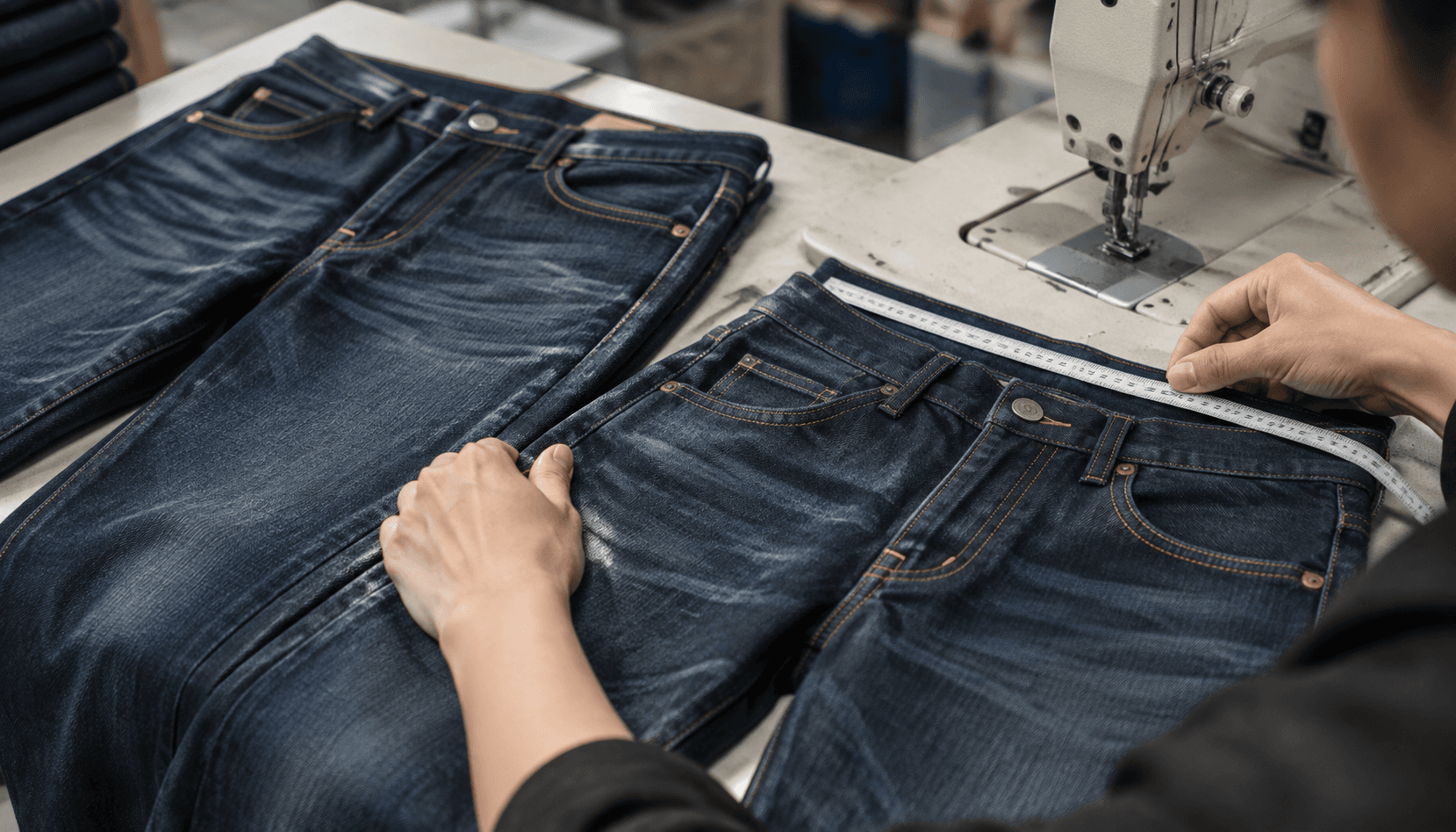
When choosing a custom denim manufacturer, many people start by looking at workshop photos, equipment counts, and capacity figures. That information isn't useless, but it can't answer a more fundamental question: can this factory take your approved sample and produce bulk orders with the same measurements, washes, and trims? If the answer to that question is vague, all the earlier assessments are built on shifting sand.
Consistency between denim bulk production and the approved sample isn't really a problem that emerges at the production stage — it's a dividing line already set during factory selection.
Pattern replication capability is the first threshold for screening factories
Pattern replication doesn't mean "making something roughly similar to the sample." It means the factory can break down your approved sample into executable specifications: what values are set for waist, hip, front and back rise, inseam, thigh, and leg opening, what tolerances are allowed, at which areas the wash reaches what depth, how much whiskering and grinding is retained, and which versions of main label, care label, leather patch, buttons, and zippers are used.
A factory capable of pattern replication will confirm with you during sampling: measurement method, size units, and whether measurements are taken before or after wash. A factory that can't replicate patterns will typically only say, "Don't worry, we've made similar ones before."
The difference between these two responses gets amplified at the bulk production stage. The former has a version to reference; the latter relies only on memory and verbal description.
Workshop photos and capacity figures can't replace pattern replication confirmation
Factory-provided photos can show that sewing, washing, and fabric preparation processes do exist, and the manufacturing section of a website displays these workflows. But the material shows "these processes exist," not "your style can be replicated according to your sample."
The same applies to capacity figures. The 300,000-piece monthly capacity provided by a project manager is a capability statement that needs to be confirmed against specific orders — it doesn't apply unconditionally to all styles and all schedules. Capacity answers "how much can be made"; pattern replication answers "can it be made correctly."
Conflating these two things is the most common misjudgment when selecting a factory.
Three checkpoints to judge whether pattern replication capability is real
Are measurement tolerances documented? Does the size chart confirmed by both parties during sampling specify the tolerance range for each measurement point? Which specification version is used for bulk production? If the factory only says "we'll follow the sample" but can't produce a versioned measurement record, pattern replication lacks a basis. S, M, L labels in different markets cannot be directly treated as the same measurements — this is especially prone to problems in cross-market orders.
Can wash effects be traced? Denim washing is affected by fabric, construction, lighting, and screens — reference images cannot serve as an absolute color difference standard. Has the factory recorded the key wash areas and details to be retained from the sample? After switching to a new fabric lot or adjusting construction, is the factory willing to re-verify the wash effect? If a factory promises "zero color difference," that itself is a signal worth being cautious about.
Are trim versions locked? Main labels, care labels, leather patches, buttons, rivets, zippers, hangtags, and packaging — each item may have independent quantity, cost, and lead time requirements. Does the factory confirm each item individually when quoting and lock the versions after sample approval? Changing trims without re-confirmation is a common cause of bulk-to-sample discrepancies.
These three checkpoints don't require factory experience to ask about. What they test is whether the factory is willing to turn verbal promises into traceable records.
Pattern replication conditions should be written clearly during the sampling stage
Pattern replication capability isn't something to verify only before bulk production. During sampling and review, feedback on fit, measurements, fabric hand feel, color and wash, stitching, trims, and label placement should be consolidated in one pass, with photos marking specific areas and distinguishing must-change items from acceptable differences. Each revision round should retain version numbers and confirmation records; when materials or construction change, costs and timelines should be reviewed simultaneously.
Sample approval means both parties have established the production reference — it doesn't mean details the client hasn't confirmed can be decided by the factory on its own. The reverse also holds: if a factory still adjusts unconfirmed items at will after sample approval, its pattern replication capability deserves re-evaluation.
The question worth asking when selecting a factory
Rather than "how big is your factory," the more worthwhile question is: "If I give you an approved sample, can you tell me which specification, which wash version, and which trim set the bulk order will follow?"
A factory that can answer this clearly isn't necessarily the largest, but at least it has a verifiable basis for pattern replication. A factory that answers vaguely — even with complete workshop photos — still lacks assurance for bulk-to-sample consistency.
There's no universal answer for choosing a custom denim manufacturer, but there is one judgment boundary: if pattern replication conditions can't be written into confirmation records, that factory isn't suitable for orders requiring strict consistency. If your style has clear requirements for measurements, wash, or brand details, first confirm the factory is willing to document these as versioned records — then discuss pricing and scheduling.