Men's denim fit development: which items on the acceptance checklist should be settled before quoting
Men's denim fit development often starts with price comparison before specs are filled in, resulting in samples that don't match the quote. From a buyer's perspective, this article explains why the acceptance checklist should come before the quotation, which measurement points and conditions must be clearly stated in the checklist, and why the two tables—available styles verification and custom confirmation—must not be mixed up. Suitable for brands and wholesalers developing men's denim who need to send comparable requirements to factories.
At the fit development stage, define the acceptance checklist first, specifying at minimum six measurement points—waist, hip, front and back rise, inseam, thigh, and leg opening—along with pre-wash and post-wash states; otherwise the quotation cannot correspond to the same specification.
In this article
Why the checklist must come before the quoteLock six measurement points firstStock verification and custom confirmation are two separate sheetsHow to use the checklist during sample reviewThe quote must reconcile with the checklistAt what point can the checklist stop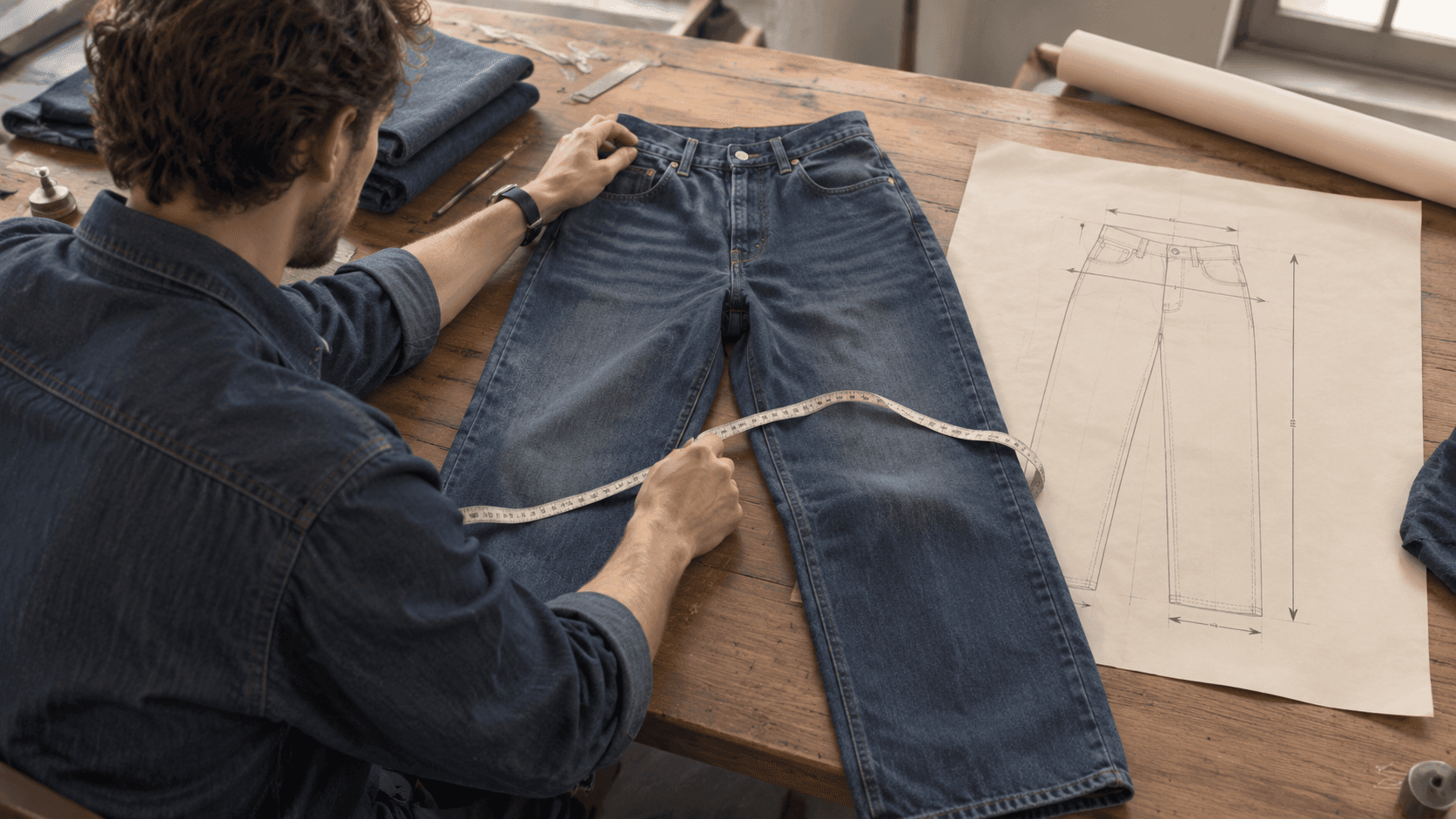
In men's denim fit development, the step most easily skipped at the quotation stage is defining the acceptance checklist first. Without a checklist, three factories quote against three different interpretations; the price gap looks like a cost issue, but it is really a specs misalignment.
Why the checklist must come before the quote
A quote requires knowing what you want. A style sketch shows appearance but cannot specify where the waist is measured, whether the hip is checked before or after wash, or whether inseam starts from the waistband or the crotch. Without these definitions in writing, factories can only quote by their own habits, and the samples that come back naturally won't match.
Conversely, with a fillable acceptance checklist first, quotes have a common basis for comparison. The checklist need not be complete at the first inquiry, but the measurement points and states that affect pricing must be marked first; the rest can be marked as pending confirmation.
Lock six measurement points first
Men's denim has at least six key areas: waist, hip, front and back rise, inseam, thigh, and leg opening. Each point must specify the measuring method, unit, pre-wash or post-wash state, and allowed tolerance.
These points are not independent. Waist and hip determine whether the garment fits; front and back rise affect mobility and seated posture; inseam and leg opening determine where the fit lands. Changing one during fit development may shift the others, so the checklist must be confirmed as a group—you cannot sign off after checking only the waist.
S, M, and L in different markets cannot be treated as identical sizes. Give the factory the target market's size chart or key measurement dimensions, not just a size label.
Stock verification and custom confirmation are two separate sheets
Stock purchasing verifies the sizes, quantities, and inventory shown on the current product page and ordering window, subject to business confirmation. Custom development verifies the spec version confirmed by both parties, and bulk production follows that version.
Mixing the two sheets causes problems: using a stock size chart to specify a custom fit, or using custom sample measurements to infer stock inventory, neither holds. Custom development reference styles show design direction only and do not mean stock is available.
For the stock path, start with stock denim sourcing; for the custom path, enter through custom denim development and private label services—the two paths verify different things.
How to use the checklist during sample review
After receiving samples, consolidate feedback in one pass covering fit, measurements, fabric hand feel, color and wash, stitching, trims, and label placement. Mark areas on photos and state the target effect. Distinguish must-change items from acceptable differences, and keep a version number and confirmation record for each round.
When materials or construction change, review cost and lead time together. Sample approval means both parties have fixed the production reference; it does not mean unconfirmed details can be decided by the factory on its own.
The checklist's role here is to give revisions a basis: record deviations by style number, quantity, photos, and measurement results; verify against the approved sample and confirmed specs; then discuss the resolution.
The quote must reconcile with the checklist
When comparing quotes, confirm whether sample fees, trims, packaging, shipping, taxes, and other services are included. Unless confirmed in the quote, do not assume free shipping, duty included, or free sampling. Check whether MOQ is calculated by style, color, or size, and do not assume quantities across different styles can be combined by default.
Some custom development reference styles indicate an MOQ of 30 pieces per style; other styles still require confirmation per proposal and cannot be treated as a blanket commitment across all styles, fabrics, or colors.
At what point can the checklist stop
Fit development does not need every detail in place before moving forward. Lock the measurement points, pre-/post-wash state, and tolerances that affect pricing first; fabric hand feel, wash effect, and brand labels can be marked pending and filled in item by item once sampling begins. What must be avoided is treating pending items as already mutually understood.
The checklist's boundary: it governs the spec version confirmed by both parties, not a guarantee of the final garment's outcome. Samples, colors, measurements, and construction records still require round-by-round confirmation.
For pre-production acceptance requirements, see how to use a denim garment quality acceptance checklist; for the sequencing of fit development and quoting, see men's denim fit development: how the acceptance checklist comes before the quote.