
Denim Cargo Pants Pockets and Construction: Check Separately by Sourcing Path
When sourcing denim cargo pants, pockets are an area where the boundary between available styles and custom development is easily confused. This article separates the two paths—buying available styles and OEM/ODM custom development—and explains the differences in pocket construction, measurement points, reference images, and sample verification, with fill-in check fields and review actions. It is intended for brands, wholesalers, and buyers who are selecting styles or preparing to develop custom cargo pants.
For available denim cargo pants, check pockets against the current product page and order window; for OEM/ODM custom styles, pocket construction, dimensions, and workmanship must be written into the specification and are subject to the approved sample—reference images are not acceptance criteria.
In this article
Available styles vs. custom: different basis for checking pocketsPocket structure: first clarify which layer you are looking atFields to specify for custom pocketsMeasurement and acceptance: observation points for pocketsComparison of the two pathsWhat to look at during review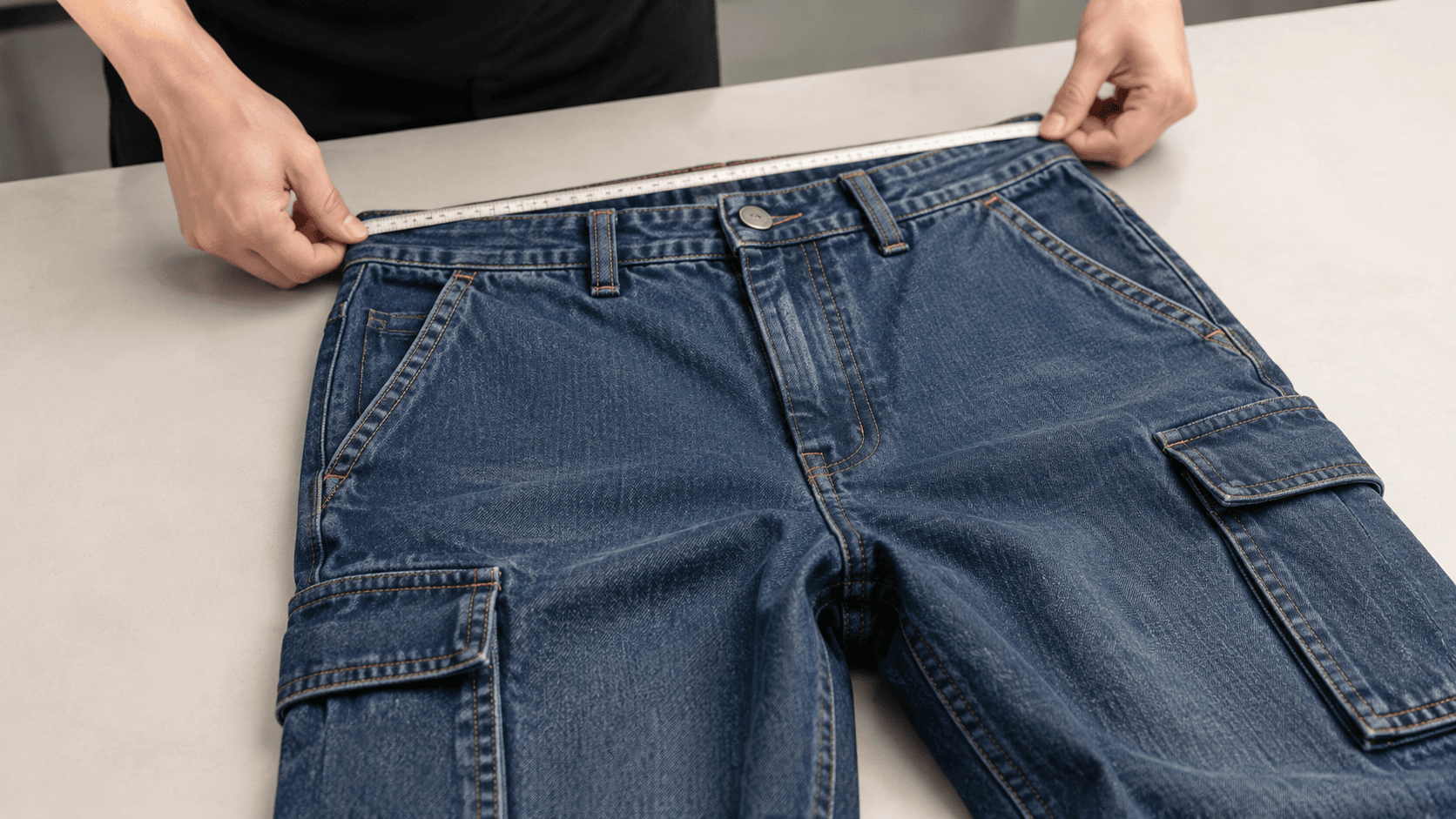
Denim workwear pockets are often discussed as a single feature, but for sourcing they need to be broken into at least two separate matters: whether you are buying available styles or a custom-developed version built to your own requirements. Under these two paths, the basis for checking pockets, the scope of what can be confirmed, and the acceptance method all differ.
Available styles vs. custom: different basis for checking pockets
When sourcing available styles, the pocket structure is based on the information shown on the current product page and in the ordering window. Flap pockets, patch pockets, and side pocket positions visible on the page are appearance descriptions; size, inventory, minimum order quantity, and price must be confirmed through the ordering window and with the business team. The knowledge base does not store fixed inventory numbers, so seeing a style listed does not mean all sizes of that style are in stock.
For OEM/ODM customization, pockets are part of the development proposal. Customers can start from reference styles and discuss pocket type, flap, pocket opening width, position, and stitching method, but these discussions need to be translated into specifications and sample garments. Reference images only help communicate design direction; they cannot prove composition, process parameters, or deliverable quantities.
Pocket structure: first clarify which layer you are looking at
Workwear pockets commonly include flap pockets, three-dimensional patch pockets, side insert pockets, and tool pockets. When viewing reference images, first determine whether you are focused on the pocket silhouette, flap shape, pocket position, or the stitching method of the pocket opening and pocket bag. These four types of information are visible to different degrees in images: silhouette and position are easy to identify, while stitching method and internal structure are often unclear.
If the reference image comes from a model shot or flat-lay photo, lighting, angle, and wearing condition can affect the visual proportions of the pocket. The same pocket may look different in how the flap sits when worn on a model versus photographed flat. This does not indicate a process problem—it simply means the image is not a measurement basis.
Fields to specify for custom pockets
When communicating about customization, the pocket section should specify at least: pocket type name, pocket opening width and depth, flap dimensions and shape, pocket position on the trouser body (which can be described by distance from waistband or side seam), pocket bag material direction, stitch color, and visible stitch placement. Whether reinforcement is needed and whether bar tacks are added at pocket openings should also be confirmed as separate items.
These fields do not need to be filled in all at once. When information is incomplete, you can first send reference images and mark the details you most want to retain, then have the business team check development feasibility. However, the final version used for production should be based on the approved sample garment and confirmed specifications—not on verbal descriptions left in chat records.
Measurement and acceptance: observation points for pockets
When checking pocket dimensions, the measurement method must be clearly defined. Is pocket opening width measured along a straight line or along a curve; is pocket depth measured vertically down from the midpoint of the pocket opening or from the lower edge of the flap—different methods will yield different values. For custom styles, the measurement definitions and allowable tolerances should be written into the specifications and verified on the sample garment.
During acceptance, check against the approved sample garment: whether the flap is symmetrical left and right, whether pocket position matches specifications, whether stitch color and stitching are within the confirmed range, and whether the pocket bag is noticeably skewed. When deviations are found, record the style number, quantity, photos, and measurement results, and confirm the handling plan with the business team. These are general checking suggestions and do not mean that ZHIZHI has obtained any particular testing certification.
Comparison of the two paths
| Check item | Available styles sourcing | OEM/ODM customization |
|---|---|---|
| Basis for pocket structure | Current product page and ordering window | Confirmed specifications and approved sample garment |
| Dimensions and tolerances | Based on page information and business confirmation | Measurement definitions and tolerances written into specifications |
| Role of reference images | Help identify appearance | Communicate design direction; not an acceptance basis |
| Changing pocket design | Contact business to confirm supply availability or switch to custom | Re-check sample garment and cost/timeline after modification |
Under the available styles path, if the required pocket structure differs from what is shown on the page, contact the business team to confirm supply arrangements or move to custom communication. Under the custom path, pocket structure changes may affect fabric consumption, wash effects, and garment dimensions; after changes, the sample garment should be re-checked and not directly treated as an equivalent substitution.
What to look at during review
Regardless of the path, pocket review should refer back to specific records: for available styles, check the size quantities in the ordering window and the product page description; for custom, check the specification version, sample garment photos, and measurement records. Reference images can remain in the communication record, but should not replace specifications or sample garment confirmation.
If pockets are a key part of this sourcing, the next step is to write your concerns into checkable fields—pocket type, dimensions, position, stitching—and then confirm item by item against the current product page or sample garment.