Stretch denim or rigid denim? First, look at where you are in your private label customization process
Addressing a common concern for brands and buyers when selecting styles: how to choose between stretch denim and rigid denim depends on the target market, fit requirements, and the conditions of the confirmed sample garment. Starting from the boundaries of available information, this article explains that fabric parameters should come from confirmed specifications, that stretch styles require confirmation of both stretch and recovery, and reminds readers to re-check samples after any fabric change. Suitable for readers who are advancing a private label customization process and need clarity on confirmation checkpoints at each stage.
Choosing between stretch and rigid denim cannot rely on hand feel alone—it affects fit, dimensional tolerances, and wash results; in the denim garment private label customization process, fabric parameters should be confirmed before sampling rather than judged from photos.
In this article
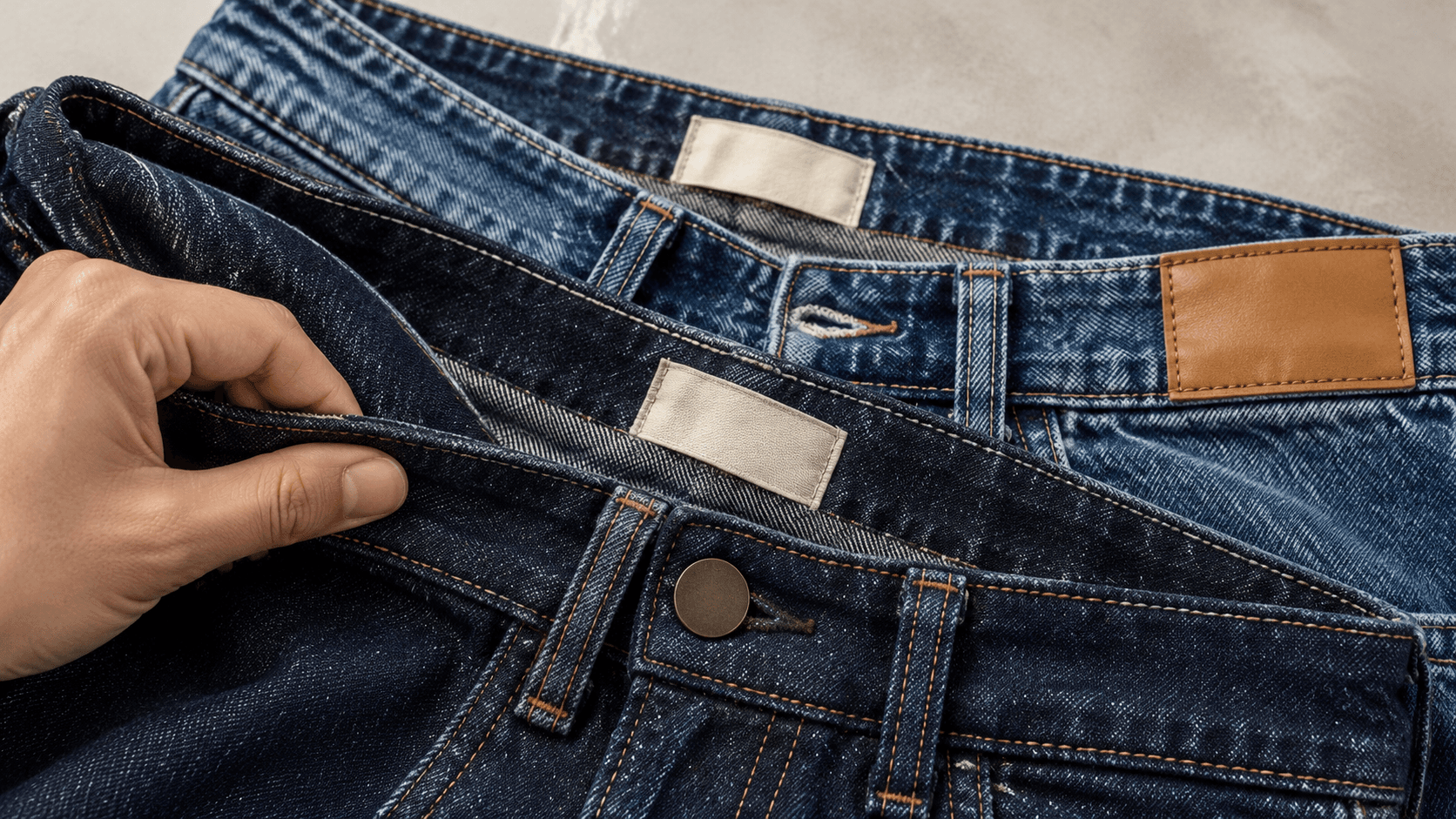
The choice between stretch denim and non-stretch denim is often reduced to a single question: "Which one sells better?" But in actual sourcing, the more accurate question is: Where are you in your private label custom process, and what verifiable information do you have on hand? If you are still at the style selection stage, reference images alone cannot determine composition, stretch, or wash effects. If you have already moved into sampling, fabric parameters and fit requirements need to be confirmed together.
First, distinguish: Are you looking at reference images or specifications?
Model shots, flat-lay photos, and detail images in custom product galleries are used to communicate style structure and design direction. These images do not prove that physical samples exist, that stock is available, or that mass production capability is in place, nor can they be used to derive accurate composition and process parameters. The first step in choosing between stretch and non-stretch denim is not comparing images, but confirming whether fabric specifications or sample records currently exist.
If you only have reference style images, you can first clarify the intended use, season, hand-feel preference, and whether stretch is needed, then ask the supplier to provide confirmable fabric information. Accurate parameters such as composition, weight, yarn, and weave should come from confirmed product specifications, fabric documentation, or sample records.
Stretch styles: Ask about stretch and recovery together
For styles that require stretch, you cannot simply ask "Is there stretch?" during communication. You should confirm stretch, recovery, and garment fit requirements at the same time. The recovery performance of stretch fabric affects dimensional stability after wear, and this cannot be seen in images. Non-stretch or structured styles also need to be discussed in terms of range of motion and size design—do not assume that non-stretch automatically means a good fit.
Here is an easily overlooked boundary: fabric substitution may affect color, wash, hand-feel, and garment dimensions. After any change, samples should be re-checked and not treated as equivalent substitutes. Switching between stretch and non-stretch especially requires re-confirming fit and dimensional tolerances.
Where fabric confirmation sits in the private label custom process
In the five stages of custom development, the second stage is confirming the plan: verifying fabric, wash, trims, and brand labels, and discussing pricing and scheduling. The third stage is sampling and review: checking fit, dimensions, and garment effect. If fabric parameters are not finalized before this step, sampling may go through repeated rounds.
After receiving samples, it is recommended to consolidate feedback on fit, dimensions, fabric hand-feel, color and wash, stitching, trims, and label placement in one go, marking areas on photos and stating the target effect. Distinguish between must-change items and acceptable differences, and keep version numbers and confirmation records for each round of revisions. Sample approval means both parties have settled on the production reference—it does not mean that unconfirmed details can be left to the factory's discretion.
How to move forward when information is incomplete
For a first inquiry, it is recommended to provide reference style numbers or product links, target market, estimated quantity per style, color and size breakdown, fabric or hand-feel requirements, wash effects, brand label and packaging requirements, target delivery date, and destination country. If information is incomplete, you can start by sending reference images and explaining which details you most want to keep or adjust. Customer service will first confirm whether it is available stock or custom, then follow up on the missing items that affect pricing.
If quantities are small, you can first discuss available stock for test sales or sample development, then verify whether custom production can be arranged. Some website custom development reference styles are marked with a minimum of 30 pieces per style; MOQs for other custom styles still need to be confirmed based on the plan. The 30-piece figure cannot be treated as a uniform commitment for all styles, fabrics, or colors.
A practical decision sequence
First ask yourself: Is there evidence behind your target market's preference for stretch, or is it just a feeling? Is the fit relaxed straight or slim, and how much range of motion is needed? Does the wash effect depend on the fabric's recovery or structure? Once these three questions are answered, move on to fabric confirmation.
For MOQ and process confirmation points on small-batch custom production, see Small-Batch Denim Private Label Custom: 30-Piece MOQ and Process Confirmation Points. For a complete understanding of the collaboration from design drawing to shipment, see denim custom development and private label services.
The choice between stretch and non-stretch ultimately comes down to samples and confirmed specifications. Images can help communicate direction, but they cannot replace fabric parameters and garment effect confirmation.